
 By Robert Smith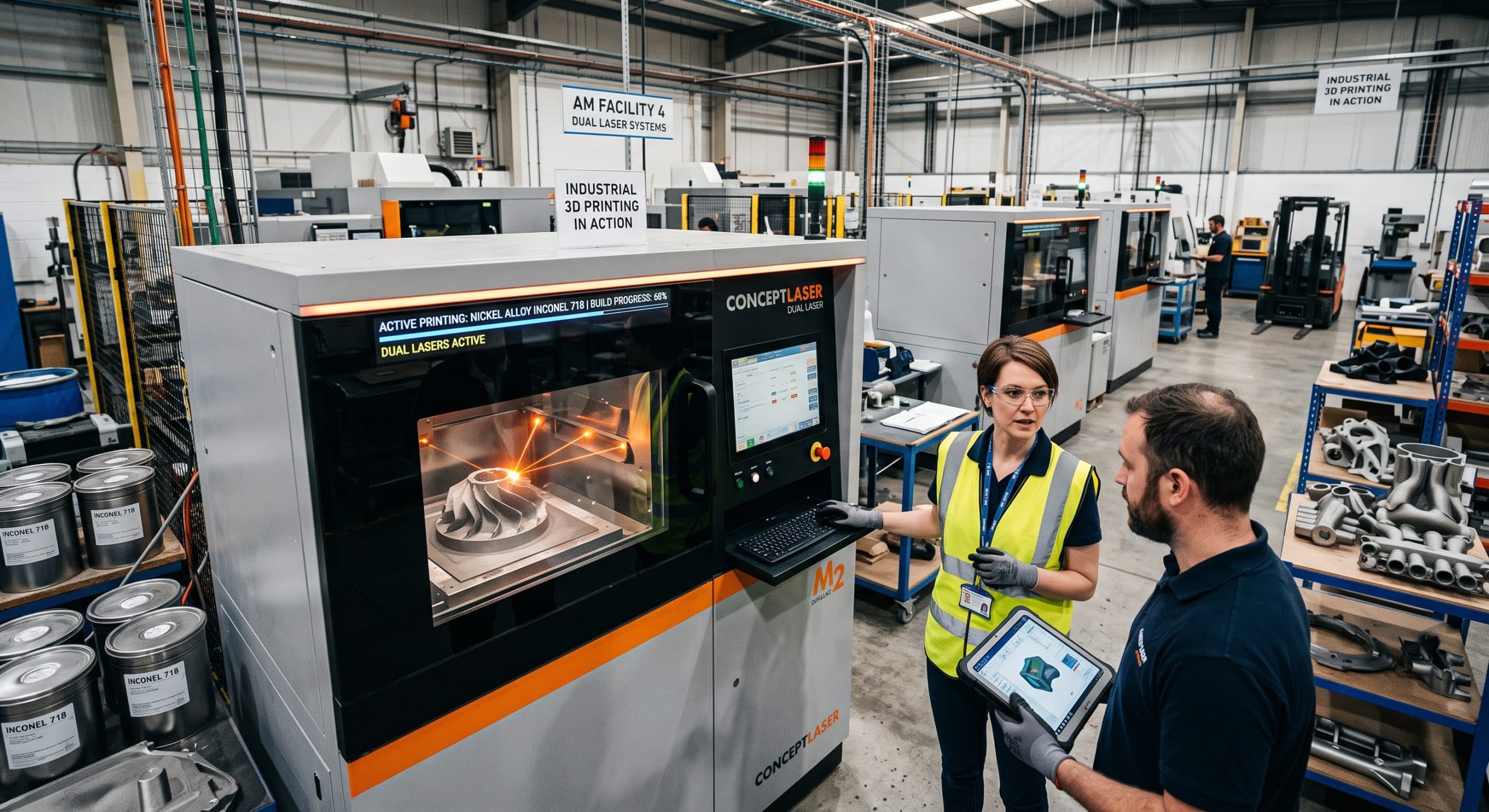
A plant manager once called me on a Friday afternoon with a simple question about whether industrial 3D printing technology could solve an urgent downtime issue. A gearbox bracket on one of his packaging lines had cracked, the machine had been down for three days, and the original equipment maker had quoted him eleven weeks for a replacement. So he wanted to know if we could “just print it.”
On the surface, that sounds technical. In reality, he was asking whether this whole additive thing was real, or just something that looked nice in a booth at a trade show.
Back then, my answer was “sometimes.” Today the answer is a lot more interesting, and that’s why I want to walk you through what industrial 3D printing technology actually does inside a working factory. I’m not talking about the glossy brochure version. Instead, I mean the version I see as an additive manufacturing engineer who has spent years designing parts for powder bed machines, arguing with build preparation software, and explaining to procurement teams why a part that costs more per unit can still save them serious money.
Let’s get into it.
What Do We Actually Mean by “Industrial”?
When most people hear “3D printing,” they picture a small plastic printer on a desk making phone stands and figurines. That’s fine, and I own one too. However, it has about as much in common with a production additive cell as a garden hose has with a fire truck.
In short, what makes a process “industrial” isn’t the size of the machine. It’s the fact that the process is controlled, documented, repeatable, and backed by material data you can put in front of a quality engineer without getting laughed out of the room.
The Processes You’ll Actually See on the Floor
The international standard ISO/ASTM 52900 groups additive processes into seven families. On a real shop floor, though, you’ll mostly run into five of them.
Laser powder bed fusion (LPBF). A laser melts thin layers of metal powder, one slice at a time. Because it handles titanium, nickel alloys, stainless steel, aluminum, and cobalt chrome, this is where most of the aerospace and medical headlines come from.
Binder jetting. A print head deposits liquid binder into a bed of powder, and then the part is sintered in a furnace. It’s fast and it scales well, so anyone watching high volume metal production keeps a close eye on it. It’s also used to print sand molds for casting.
Directed energy deposition (DED). Here, wire or powder is fed into a melt pool created by a laser, electron beam, or arc. Generally, you’ll see it on big parts, repairs, and features added onto existing components.
Selective laser sintering (SLS) and Multi Jet Fusion (MJF). These are polymer powder processes, mostly running nylon. In fact, they’re the quiet workhorses behind a huge number of end use plastic parts, housings, ducts, and production tools.
Material extrusion with engineering polymers. Yes, it’s the same basic idea as a desktop printer. But the industrial versions use heated chambers, carbon fiber filled materials, and plastics like PEEK and ULTEM that survive real heat and real chemicals.
The Numbers Tell a Grown Up Story
I get a little tired of hype in this field, so let’s look at what the data says about industrial 3D printing technology, straight from people who have tracked it for decades.
The Wohlers Report 2025, published with ASTM International, put the global additive manufacturing market at $21.9 billion for 2024, with growth of 9.1 percent. That was a bit slower than the 11.1 percent seen the year before. Since then, the Wohlers Report 2026 has valued the market at $24.2 billion.
A few details from that research are worth pausing on:
- Service providers accounted for roughly 47 percent of total revenue, which makes them the single biggest slice.
- Polymer systems still make up about 67 percent of installed machines, while metal sits at roughly 30 percent.
- Meanwhile, metal machine makers had a rough year, with estimated sales down around 26 percent.
Here’s how I read that. The industry isn’t a rocket ship anymore, and I think that’s a good sign. Instead of exploding, it’s growing the way a mature manufacturing technology grows, which is steadily. Also, the fact that services lead the market tells you most companies aren’t buying printers. Rather, they’re buying parts, engineering help, and capacity from people who already know how to run the machines. I’ll come back to that later, because it matters a lot for anyone in the business and professional services world.
Part Consolidation Is the Real Revolution
If you ask me which idea changed my thinking the most, it’s this one. With additive, complexity is close to free, because the machine doesn’t care how complicated the shape is. As a result, a part full of internal channels and curved passages costs roughly the same to print as a plain block of the same volume.
That flips a hundred years of design habits upside down.
The example everyone in my field knows is the fuel nozzle tip GE developed for the LEAP jet engine. Originally, that design was assembled from 20 separate pieces that had to be brazed and welded together. By contrast, the printed version is a single part. According to GE, it also came out about 25 percent lighter, five times more durable, and around 30 percent more cost efficient to make. Since then, GE has shipped more than 100,000 of these nozzles from its plant in Auburn, Alabama.
After that success, GE pushed the idea even further. On the Catalyst turboprop engine, the team took 855 conventionally made components and consolidated them into about a dozen printed parts.
Why It Matters Outside Aerospace
Now, you might be thinking, “That’s aerospace. My shop makes pumps.” Fair enough. Still, the logic scales down beautifully.
Every joint you remove is a joint that can’t leak, loosen, or crack. Likewise, every part you eliminate means one less drawing to control, one less supplier to manage, one less inspection step, and one less item sitting on a warehouse shelf.
For example, I’ve worked on manifold blocks that went from six machined and plugged pieces to one printed body with smooth internal flow paths. As a result, the pressure drop improved, the leak points disappeared, and the assembly technician got an hour of his day back on every unit.
That’s the side of industrial 3D printing technology that rarely makes the news. It isn’t about making the same part a new way. Rather, it’s about making a better part that simply wasn’t possible before.
It’s Starting to Win on Cost, Not Just Performance
For years, the knock on additive was simple: “It’s great for exotic stuff, but it’ll never beat casting on price.”
Thanks to better machines and smarter design, that argument against industrial 3D printing technology is getting weaker every year.
In 2021, GE Aerospace published a case study on four bleed air adapter caps for its LM9000 turbine. These were ordinary cast cobalt chrome parts, nothing fancy. When the team converted them to printed parts on a straight swap basis, the additive versions came in about 35 percent cheaper than the castings. Also, the project took around ten months from picking the parts to having final prototypes, compared with the 12 to 18 months or more that a new casting often needs. Their audit of that engine then flagged 180 cast parts as possible candidates for conversion.
One of the engineers on the project summed it up well. It was the first time they had done a direct replacement where additive was cheaper than casting.
Of course, I want to be careful here, because additive doesn’t beat casting on every part. For a simple shape made in the tens of thousands, casting or machining will usually win, and you should use them. But for low to medium volumes, parts with long tooling lead times, or anything where the mold would cost more than the whole production run, the math has clearly shifted. Therefore, the smart move is to run the numbers part by part instead of assuming either way.
The Unsung Heroes: Jigs, Fixtures, and Tooling
If you want my opinion on where most manufacturers should start with industrial 3D printing technology, it’s not flight hardware. Instead, it’s the stuff that never leaves the building.
Think about assembly jigs, drilling guides, inspection gauges, alignment fixtures, soft jaws, and masking tools. Every factory has hundreds of these, and most are machined from aluminum by an outside shop that takes weeks to deliver.
Two Case Studies Worth Knowing
Volkswagen Autoeuropa in Portugal is the example I share most often. Using a handful of polymer printers in house, the plant reported a 91 percent reduction in tool development costs and a 95 percent reduction in development time. For instance, one wheel protection jig dropped from about €800 to €21, and from 56 days to 10 days. As a result, they recouped their initial investment in roughly two months, and at one point they were producing 93 percent of the tools they used to buy from outside.
Similarly, Standard Motor Products in the United States worked with Xometry to move production tooling from CNC machining to SLS and FDM printing. Lead times dropped by more than 70 percent, and one tool went from about $1,500 to $200. These weren’t prototypes sitting in a drawer, either. Those printed tools were used more than 200 times a day, and some lasted over three years on a busy automotive line.
That’s why I push clients toward tooling first. The risk is low, since a failed fixture won’t bring down an airplane. The payback is also fast. Most importantly, your engineers learn how the technology behaves on real problems before you ever bet a customer facing part on it.
Spare Parts and the Idea of a Digital Warehouse
Remember that plant manager with the cracked bracket? His problem is one of the most expensive and least discussed problems in manufacturing. Legacy equipment runs for decades, while the companies that built it move on, raise prices, or disappear. Consequently, plants either keep huge inventories of spare parts “just in case,” or they wait. And waiting costs money every hour the line is down.
Deutsche Bahn, the German national railway, has been tackling this for years. In 2023, it announced its 100,000th printed spare part. By then it had around 1,000 digital part models in its system, with a goal of reaching 10,000 different components by 2030.
Interestingly, the milestone part was a gear housing for a shunting locomotive that weighed about 570 kilograms. DB made it by printing a sand mold with binder jetting and then casting the housing in it. Normal procurement for that housing averaged around ten months, but with the printed mold it took about two.
What a Digital Warehouse Really Needs
That’s what people mean by a digital warehouse built on industrial 3D printing technology. Instead of storing thousands of physical parts that might never get used, you store validated files, material specs, and process settings. Then, when a part is needed, you print it close to where it’s needed. As a result, you tie up less capital on shelves, write off less obsolete stock, and pay for less freight.
However, I’ll add one warning from experience. The file is the easy part. What makes a digital warehouse work is the paperwork behind each file, including the approved material, printer settings, post processing steps, and inspection criteria. Without that, you don’t have a warehouse. You just have a folder full of hope.
You Have to Design Differently, or It Won’t Pay Off
This is the mistake I see most often, and I made it myself early in my career.
Someone takes a part that was designed to be machined from a solid block, sends the same CAD file to a metal printer, and then complains that it was slow and expensive. Of course it was, because they used a very capable, very costly process to copy a shape that a mill makes faster.
On the other hand, design for additive manufacturing, or DfAM, calls for a different mindset. For example, you think about build orientation from the start, since it affects surface finish, support structures, and strength. In addition, you look for places to remove material that isn’t doing any work, often with topology optimization software that shows where the loads actually travel.
Lattice structures are another tool, because they add stiffness without adding much weight. Conformal cooling is a good example too. When printed injection mold inserts have cooling channels that follow the shape of the part, cycle times can drop noticeably. Finally, you plan how supports will be removed before you ever hit “print.”
Whenever I train new engineers, I tell them to stop asking “Can we print this part?” and start asking “If we were free to make any shape, what would this part want to look like?” Over time, that one question changes everything.
What Nobody Tells You at the Trade Show
I’d be doing you a disservice if I only talked about the wins that industrial 3D printing technology delivers. So here’s the less exciting side.
Qualification is slow and expensive. NIST, the U.S. National Institute of Standards and Technology, has noted that qualifying additive parts for critical applications can require thousands of individual tests, cost millions of dollars, and take several years. The issues behind this are real, including internal porosity, residual stress, properties that vary with build direction, and complex shapes that are hard to measure. Therefore, if you’re in a regulated field, budget for qualification from day one.
Post processing is half the job. In many cases it’s even more than half, since metal parts often need stress relief, support removal, heat treatment, hot isostatic pressing, machining of critical surfaces, and finishing. So when someone quotes you a print price, ask what’s included after the part comes off the build plate.
Consistency depends on people and process control. Two identical machines can produce different results when powder handling, calibration, and parameters aren’t managed tightly. That’s why the best additive shops I know are almost boring in how disciplined they are.
Safety is not optional. Fine metal powders can be combustible, and they’re also a respiratory hazard. For that reason, proper handling, inert gas management, and training are part of the cost of doing this right.
Nevertheless, none of this is a reason to stay away. Instead, it’s a reason to go in with clear eyes and good partners.
Why This Matters for Business and Professional Services
Here’s something I find really interesting. The biggest opportunities created by industrial 3D printing technology aren’t only for the companies making parts. They’re also for the people helping those companies figure it out.
As I mentioned earlier, services make up nearly half of the market. That includes print bureaus, but it also includes a whole ecosystem around them:
- Engineering consultancies that help clients choose which parts are worth converting, and then redesign them properly.
- Testing and inspection labs that handle CT scanning, mechanical testing, and material certification.
- Software and data specialists who build and manage digital inventories, part libraries, and traceability systems.
- Training providers who teach DfAM, machine operation, and powder safety.
- Supply chain advisors who help manufacturers decide what to print, what to stock, and what to keep buying the old way.
So if you run a professional services firm that already works with manufacturers, this is a conversation worth having with your clients. In most cases, they don’t need a printer. Rather, they need someone who can tell them which 5 percent of their parts would actually benefit, and how to get those parts qualified without wasting a year.
How I’d Start If I Were in Your Shoes
People ask me this all the time, so here’s the short version of what I tell them.
- Walk the floor and list the pain. Look for tooling with long lead times, spare parts that keep equipment down, and assemblies with lots of small welded or bolted pieces.
- Start with low risk parts. Jigs, fixtures, gauges, and non critical brackets let you learn fast without betting your reputation.
- Use a service partner before buying machines. That way, you’ll learn which processes and materials fit your parts, and you’ll get real cost data instead of brochure numbers.
- Redesign, don’t just reprint. Bring in someone who knows DfAM, because the savings usually live in the redesign.
- Document everything. Record material, settings, orientation, post processing, and inspection. Over time, that record becomes your competitive advantage and the foundation of any digital warehouse.
- Measure the full picture. Track total cost, including downtime avoided, inventory reduced, and assembly time saved, rather than just the price per part.
Final Thoughts
So, what happened with that cracked bracket? First, we reverse engineered it and beefed up the section where it had failed. Then we printed it in a glass filled nylon to get the line running, and later followed up with a metal version for the long haul. The line was back up in four days instead of eleven weeks. It wasn’t magic, though. It was simply a good tool used for the right job.
That’s really the whole story of industrial 3D printing technology in manufacturing right now. It isn’t replacing machining, casting, or molding. Instead, it’s working beside them and taking the jobs where it clearly does better, such as complex parts, consolidated assemblies, fast tooling, and spare parts nobody wants to stock.
Ultimately, the companies getting the most out of it aren’t the ones with the most printers. They’re the ones who learned to think differently about how parts are designed, made, and stored.
If you’ve been waiting for the technology to “mature,” I’d gently tell you it already has. So the real question now is whether your team has the know how to use it well.
Frequently Asked Questions
What is industrial 3D printing technology? It’s the use of controlled, production grade additive processes, such as laser powder bed fusion, binder jetting, and selective laser sintering, to make functional parts, tooling, and spare parts in metal and engineering polymers. ASTM International’s Committee F42 on Additive Manufacturing Technologies sets many of the standards behind it.
Is industrial 3D printing cheaper than traditional manufacturing? It depends on the part. For high volume simple shapes, casting and machining usually win. However, for low to medium volumes, complex geometries, and anything needing expensive tooling, additive can be cheaper. For example, GE reported about 35 percent savings over casting on four turbine parts. Read the case study on GE Aerospace News.
Which industries use industrial 3D printing the most? Aerospace, medical and dental, automotive, energy, rail, and industrial equipment are the heaviest users. Market figures are tracked in the Wohlers Report 2025 from ASTM.
What is the easiest way for a manufacturer to get started? Most companies start with jigs, fixtures, and production tooling, because the risk is low and the payback is fast. UltiMaker’s Volkswagen Autoeuropa case study is a good example.
How long does it take to qualify a 3D printed part? For non critical parts, it can take weeks. On the other hand, safety critical parts in aerospace or medical can take years and a large testing budget. NIST’s Additive Manufacturing Part Qualification project explains why.
What is a digital warehouse for spare parts? It’s a library of validated part files and process data that lets a company print spare parts on demand instead of stocking them physically. Deutsche Bahn’s 3D printing program is one of the best known examples.
References
ASTM International. (2026). New Wohlers Report 2026 Values Additive Manufacturing Market at $24.2B. https://www.astm.org/news/press-releases/wohlers-report-2026
ASTM International. (2025). Wohlers Report 2025 Shows 9.1% AM Industry Growth. https://www.astm.org/news/press-releases/wohlers-report-2025
3Dnatives. (2025). Wohlers Report 2025: 9.1% Growth for the Global Additive Manufacturing Market. https://www.3dnatives.com/en/wohlers-report-2025-growth-global-additive-manufacturing-140420256/
GE News. Transformation in 3D: How a Walnut Sized Part Changed the Way GE Aviation Builds Jet Engines. https://www.ge.com/news/reports/transformation-3d-walnut-sized-part-changed-way-ge-aviation-builds-jet-engines
3DPrint.com. GE Aviation Announces 100,000th 3D Printed Fuel Nozzle Shipped from Auburn Plant. https://3dprint.com/284243/ge-aviation-announces-100000th-3d-printed-fuel-nozzle-shipped-from-auburn-plant/
GE Aerospace News. (2021). Game Changer: Four Parts Proving Additive Manufacturing Can Compete with Casting on Cost. https://www.geaerospace.com/news/articles/technology/game-changer-four-parts-proving-additive-manufacturing-can-compete-casting-cost
UltiMaker. Volkswagen Autoeuropa: Maximizing Production Efficiency with 3D Printed Tools, Jigs, and Fixtures. https://ultimaker.com/learn/volkswagen-autoeuropa-maximizing-production-efficiency-with-3d-printed-tools-jigs-and-fixtures/
Xometry. Case Study: Standard Motor Products Uses 3D Printing to Reduce Tool Lead Time by Over 70%. https://www.xometry.com/resources/case-studies/standard-motor-products-used-3d-printing-to-reduce-part-lead-time-by-over-70/
VoxelMatters. (2023). Deutsche Bahn (DB) 3D Prints 100,000th Part. https://www.voxelmatters.com/deutsche-bahn-db-3d-prints-100000th-part/
Deutsche Bahn. Printing in Progress: DB at Work. https://www.deutschebahn.com/en/3d_printing-6935100
National Institute of Standards and Technology. Additive Manufacturing Part Qualification. https://www.nist.gov/programs-projects/additive-manufacturing-part-qualification