
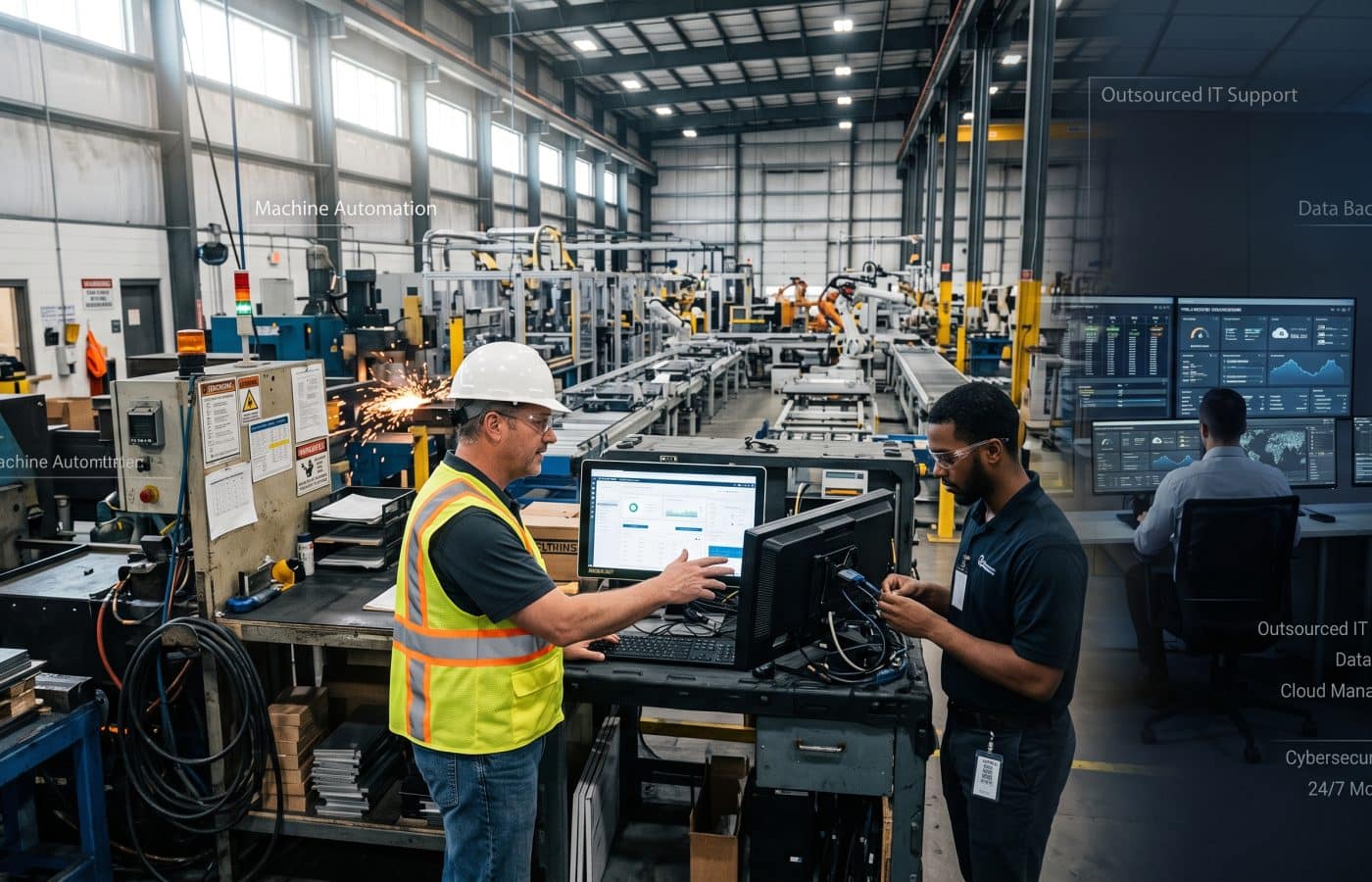
Managed IT Services for Manufacturing: What to Outsource and What to Keep

Every manufacturing IT services decision I make today traces back to one phone call. It came at 2:40 on a Tuesday morning. A line lead on second shift could not pull work orders, and the label printers on packaging had also stopped talking to the server. In fact, somebody had already started writing part numbers on masking tape. As it turned out, the cause was an expired certificate on a server nobody had touched in three years. The fix took eleven minutes. However, getting the floor back in rhythm took most of the shift.
I have run IT in manufacturing plants for a long time now, and nights like that taught me more about outsourcing than any sales deck ever did. After all, the question is never really “should we use a managed services provider?” Almost every plant my size already does in some form. Instead, the real question is which pieces you hand over and which pieces you guard like the tool crib keys.
This article, therefore, is my honest answer to that question. It is not a vendor pitch. Over the years, I have hired good providers, fired bad ones, and pulled work back in house more than once. So here is what I have learned about manufacturing IT services and where the line between outsourcing and ownership should sit.
Why Manufacturing IT Services Are a Different Animal
If you come from an office IT background, a plant will humble you quickly. In an office, downtime is an inconvenience. On a production floor, by contrast, downtime means scrap, overtime, missed trucks, and a customer who starts calling your competitor.
Two Worlds Under One Roof
We essentially run two very different worlds under one roof. First, there is the business side: email, ERP, accounting, quoting, and the engineering file shares where our rapid prototyping designs live. Second, there is the operational technology side: PLCs, HMIs, SCADA, machine controllers, vision systems, industrial 3D printing cells, and the industrial PCs bolted to equipment that may be older than some of our operators.
Naturally, those two worlds have different priorities. On the business side, confidentiality matters most. On the floor, however, availability and safety come first, because a reboot at the wrong moment can ruin a batch or hurt someone.
NIST recognized this split formally. In fact, its operational technology security guide focuses on improving OT security while respecting the unique performance, reliability, and safety needs of those systems. For that reason, this one idea should shape every manufacturing IT services decision you make. Otherwise, a provider who treats a PLC network like a branch office will eventually cause you an outage.
Why Attackers Love Plants
Meanwhile, the threat picture makes the stakes even higher. For example, IBM’s X-Force team found that manufacturing became the most attacked industry in 2021, taking 23.2% of the attacks they handled, and things have not improved since. Similarly, Check Point counted 1,466 ransomware incidents against manufacturers around the world in 2025, with the United States alone accounting for 713 of them. In addition, GuidePoint Security reported a 58% jump in ransomware victims over the prior year, with manufacturing taking the largest share at 14% of attacks.
Attackers go after plants because they know we cannot afford to sit still. A bank, for instance, can work around a slow day. A stamping line with a customer shipping window, on the other hand, cannot.
The Rule I Use Before Outsourcing Manufacturing IT Services
Over the years, I boiled my thinking down to one simple test. For every IT function, I ask:
Can someone who has never walked our floor do this well?
If the answer is yes, then it is a strong candidate for a managed provider. After all, password resets, laptop imaging, email security, and patching office PCs do not require knowing that Line 4 runs a recipe change every Thursday or that the paint booth controller hates network scans.
If the answer is no, however, that work stays with my team. At the very least, my team holds the steering wheel while a partner helps.
A second question follows close behind: If this provider disappeared tomorrow, could we keep running? Consequently, anything that fails that test needs documentation, shared credentials, and a plan B before it ever leaves our hands.
Which Manufacturing IT Services I Outsource (and Why I Sleep Better)
Help Desk and User Support in Manufacturing IT Services
This is the easiest win. Most tickets in a plant, after all, are the same as tickets anywhere else: locked accounts, printer drivers, Outlook acting up, or a new hire who needs a laptop by Monday. As a result, a good provider handles these faster and cheaper than I can with my own staff, especially across three shifts.
The trick, though, is setting up the routing rules properly. Our provider takes anything on the office side. However, the moment a ticket mentions a machine, a line, or a production system, it gets escalated to my team immediately. We learned that the hard way after a well meaning technician tried to “fix” a slow HMI by pushing an update to it.
Round the Clock Monitoring and Security Operations
Frankly, I cannot staff a security operations center, and very few manufacturers can. Therefore, a managed detection and response service watches our endpoints, firewalls, and logs at 3 AM when my team is asleep. That coverage is worth every dollar.
Ransomware crews especially love weekends and holidays. For example, GuidePoint noted that most attacks in 2025 landed in the final quarter of the year, with attackers exploiting end of year gaps, and December was the busiest month on record. Since plants run skeleton crews over the holidays, that is exactly when you want a team of analysts watching for you.
Still, there is one requirement I never bend on. The provider must call a named person on my team before taking any containment action that could touch production. Isolating a laptop is fine. In contrast, isolating a server that feeds the MES in the middle of a shift is a decision a human on site makes.
Backup, Disaster Recovery, and Offsite Copies
Backups are boring until the day they are the only thing that matters. For this reason, I outsource the infrastructure, the monitoring, and the immutable offsite copies. In other words, the provider owns making sure jobs succeed and alerting me when they do not.
What I keep, however, is the testing. Every quarter, my team restores something real, such as an ERP database copy, a set of CNC programs, or a PLC project file, and then proves it works. After all, a backup report that says “successful” means nothing until you have restored from it with your own hands.
Also, do not forget the floor. Many plants back up every server but have no current copy of the program running in a ten year old controller. Then, when that controller dies, you discover the only copy lived on a retired engineer’s laptop. So put PLC programs, robot backups, and HMI projects on the backup schedule too.
Patching and Endpoint Management for the Office Network
Similarly, monthly patching for office PCs, laptops, and standard business servers is a perfect job for a provider. It is repetitive, it needs consistency, and, above all, it eats time my team should spend on the floor.
That applies to the office network only, though. Industrial PCs and anything running a vendor validated build get handled differently, as I explain below.
Microsoft 365, Email Security, and Licensing
Likewise, tenant management, mail filtering, license tracking, and multifactor authentication rollouts are well understood work. A good provider has done it hundreds of times. Therefore, I would rather pay for that experience than have my engineers learn admin portals by trial and error.
Specialized Projects
Wireless surveys for a new warehouse, a firewall replacement, networking a new additive manufacturing cell, or a cloud migration for file shares are short projects that need skills my team uses once every few years. Consequently, bringing in a provider for the project, with my people shadowing, is far cheaper than hiring for it.
Besides, I am not alone in leaning on outside help for manufacturing IT services. Comarch reports that 42% of industrial manufacturers already outsource IT work for automation control systems, simulation software, and analytics tools. In short, outsourcing is normal. Outsourcing the wrong things, however, is the problem.
Which Manufacturing IT Services I Keep In House
The OT Network and Anything Touching a Controller
This is my hardest line. The production network, the switches on the floor, the firewall rules between the plant and the business network, and every connection to PLCs and HMIs all stay with people who know our equipment.
Why? Because the knowledge needed is local and physical. For instance, my team knows that a certain injection press loses its mind if it sees broadcast traffic. They also know which vendor needs remote access on which days and under whose supervision. Moreover, they know that patching an industrial PC can void the machine builder’s support agreement. As a result, no ticket queue in another city can hold that context.
Network segmentation, in particular, is where this matters most, and it sits at the heart of OT cybersecurity. Flat networks are how a phishing email in accounting turns into a stopped line. Therefore, whoever designs and maintains the wall between office and floor needs to understand both sides. In my experience, that means someone who walks the floor every week.
Of course, I will bring in outside OT security specialists for assessments and incident response retainers, since they are valuable. Nevertheless, the day to day ownership stays inside.
Ownership of the ERP and MES
The ERP and MES are the nervous system of the plant. A provider can certainly host them, back them up, and patch the operating systems underneath. What they cannot do, however, is own them.
Owning means knowing how a bill of materials change ripples into purchasing. It also means understanding why scheduling built a certain workaround in 2019. Above all, it means being in the room when operations wants a new report or quality needs a new inspection step. Because those decisions shape how the business runs, handing them to an outsider leads to slow, expensive, and sometimes wrong answers.
Deloitte’s outlook work, moreover, has been pointing the same direction. Their 2025 manufacturing outlook called for manufacturers to revisit industrial data and manufacturing execution systems as the foundation for smart operations. Clearly, you cannot build that foundation if nobody inside the company truly understands it.
The Relationship With Production
Simply put, nobody can outsource trust. My team eats lunch with maintenance, keeps their CMMS running, and knows the shift supervisors by name. So when a supervisor tells me a scanner “feels slow,” I know whether that means a real problem or a bad Monday.
This relationship, in turn, is what turns IT from a cost center into a partner in uptime. A provider will never get the late night text from a plant manager that says “something feels off on Line 2.” Yet that early warning has saved us more than once.
The IT Roadmap and Vendor Management
Strategy also stays inside. Providers will happily tell you what to buy, and some of them even get paid when you buy it. For that reason, planning budgets, choosing platforms, and deciding when to replace aging equipment are calls my team makes with leadership.
The same goes for managing the provider itself. Somebody inside has to read the monthly reports, question the ticket metrics, and push back when service slips. Otherwise, the provider quietly becomes your IT department, and you lose the ability to judge whether your manufacturing IT services are any good.
The Keys
Finally, domain admin credentials, firewall admin accounts, cloud tenant global admin, and the break glass accounts all stay under our control. The provider instead gets the access they need through named accounts we can audit and revoke. I once watched a manufacturer get stuck in a nasty breakup with a provider who held every password. So do not let that be you.
The Gray Zone: Shared Manufacturing IT Services
Some things, however, do not fit neatly into either bucket. For these, I use a comanaged model, where the provider and my team share the work with clearly written lines.
The Boundary Firewall and Vulnerability Scans
For the boundary firewall, the provider monitors it and handles firmware updates during agreed windows. Meanwhile, my team approves every rule change that touches the plant network.
Vulnerability management works in a similar way. The provider scans the office network on a schedule. On the floor, by contrast, we use passive monitoring only, and my team decides when and how to address findings, often together with the machine builder.
Connected Equipment and Vendor Remote Access
More machines now ship with cloud dashboards and remote service portals for predictive maintenance. Accordingly, the provider can help harden the cloud side, while my team owns the decision about which machines are allowed to talk out at all.
Vendor remote access, meanwhile, is one of the most common ways attackers get in. For that reason, we use a single, logged remote access path. The provider maintains the platform. My team, in turn, approves each session, and someone watches it.
The key to the gray zone, then, is writing everything down. A one page shared responsibility chart that both sides sign will prevent more arguments than any contract clause.
What Manufacturing IT Services Actually Cost
Typical Price Ranges for Manufacturing IT Services
Pricing varies widely depending on headcount, number of sites, and what is included. For example, one industry estimate puts outsourced IT for manufacturers somewhere between $2,000 and $8,000 per month, which matches what I have seen for smaller single plant operations. Larger multisite manufacturers with 24/7 security monitoring, however, will spend well beyond that.
What to Compare Beyond the Monthly Fee
When comparing quotes for manufacturing IT services, I also look at three things beyond the monthly number:
- What is excluded. Many agreements cover “all devices” but quietly exclude anything on the plant network or anything older than a certain age. In a factory, that can be half your fleet.
- Project rates. The monthly fee is often reasonable. Project work billed hourly, however, can double your yearly spend.
- Response times by shift. A four hour response time sounds fine until you realize it only applies between 8 AM and 5 PM, and as a result your third shift is on its own.
Comparing Against an Internal Hire
Then I compare the total against what it would cost to hire. One experienced systems administrator, plus benefits, training, tools, and coverage for vacations, usually costs more than a solid managed package for the office side. Ultimately, that math is the strongest argument for outsourcing commodity work so your internal people can focus on the floor.
How I Vet a Manufacturing IT Services Provider
I have sat through dozens of provider pitches. Over time, these are the questions that separate the ones who understand manufacturing from the ones who just added “manufacturing” to their website.
Questions About Experience and Limits
Have you supported OT environments, and can I call those clients? Not just “manufacturing companies,” but rather references from plants with real production networks.
What will you never touch without asking me first? A good provider, for instance, has a ready answer. A bad one, in contrast, says “we handle everything.”
How do you handle a patch that the machine builder has not approved? Ideally, the answer involves holding it, documenting the risk, and adding compensating controls.
Questions About Escalation, Documentation, and Reporting
What does your escalation path look like at 2 AM on a Sunday? In particular, ask for the actual names and phone tree, not a promise.
Who owns the documentation, and in what format? If the contract ends, I want every network diagram, password vault entry, and configuration file handed back in a usable form.
How do you report? Monthly reports should show trends that matter, such as repeat issues, aging equipment, and security alerts by severity, rather than a pile of closed ticket counts.
Start Your Manufacturing IT Services Partnership With a Pilot
Additionally, I ask for a short paid pilot before signing a multiyear deal. After all, ninety days on the help desk tells me more about a provider than any slide deck.
Mistakes I Made With Manufacturing IT Services
Outsourcing Before Documenting
Early in my career, I signed with a provider when half our environment lived in people’s heads. As a result, the provider spent months discovering things, and I paid for every hour. So document first, then outsource.
Letting Agents Onto Shop Floor Machines
I once let a provider push agent software onto shop floor machines. It was meant to help with monitoring. Instead, it chewed up resources on an old industrial PC and slowed a vision inspection system enough to cause false rejects. Now, therefore, nothing gets installed on a floor device without my team and the equipment vendor agreeing.
Measuring the Wrong Things
For a year, I celebrated great ticket closure numbers while the same printer issue came back every week. In hindsight, I should have measured repeat problems and root causes, not just speed.
Forgetting About People
In reality, the technology gap is rarely the biggest gap. For instance, Deloitte’s 2025 smart manufacturing survey found that while nearly half of manufacturers had training standards in place, human capital still ranked as the least mature area. Similarly, no outside manufacturing IT services team can train your operators to spot a phishing email or report a strange screen. That culture work, therefore, belongs to you.
Underestimating How Often Things Go Wrong
Furthermore, Deloitte’s 2024 cyber research found that 91% of manufacturers had dealt with at least one cybersecurity breach in the previous year. Thus, plan as though an incident will happen, because it probably will. In the same way, your provider contract, your incident response plan, and your backups should all assume a bad day is coming.
Bringing Your Manufacturing IT Services Together
If I had to put my whole philosophy on an index card, it would look like this:
Outsource: help desk, after hours monitoring, security operations, backup infrastructure, office patching, Microsoft 365, and specialist projects.
Keep: the OT network, ERP and MES ownership, the relationship with production, the roadmap, vendor oversight, and the master credentials.
Share, in writing: the boundary firewall, vulnerability management, cloud connected equipment, and vendor remote access.
In the end, the best manufacturing IT services arrangement I have ever had felt less like hiring a vendor and more like adding a bench of specialists behind my own team. They handled the repetitive work well. Meanwhile, my people spent their time where it counted: on the floor, near the equipment, with the operators who keep the plant running.
And that 2:40 AM certificate outage? Today, our provider’s monitoring would flag that certificate thirty days before it expired, and then my team would schedule the renewal during a planned changeover. That, in short, is what the right split looks like. Nobody gets a phone call, and nobody writes part numbers on masking tape.
Frequently Asked Questions
What are manufacturing IT services?
Manufacturing IT services cover the technology support a plant needs to run, including networks, servers, user support, cybersecurity, ERP and MES systems, and the connection between business systems and the production floor. In addition, managed versions of these services are delivered by an outside provider under a monthly agreement. Learn more: Comarch on IT outsourcing for manufacturing
Should a manufacturer outsource OT security?
Outsource the specialized parts, such as assessments, threat intelligence, and incident response retainers. However, keep daily ownership of the plant network with people who know your equipment. For guidance, NIST’s operational technology guide is a strong starting point. Learn more: NIST Guide to Operational Technology Security
How much do manufacturing IT services cost?
Smaller single plant manufacturers often pay a few thousand dollars per month, while larger multisite operations with full time security monitoring spend considerably more. Therefore, always check what equipment and shifts are excluded. Learn more: Apptunix on managed IT costs for manufacturing
Why are manufacturers targeted so often by ransomware?
Plants have a very low tolerance for downtime, often run older systems, and depend on complex supply chains. As a result, they are more likely to pay to get production moving again. Learn more: Smart Industry on 2025 ransomware records
What is a comanaged IT model?
It is an arrangement where your internal IT team and an outside provider share responsibilities, with clear written boundaries about who does what. Consequently, it works well for manufacturers that need outside coverage but must keep control of production systems. Learn more: IT Brief on manufacturing ransomware trends
Can manufacturing IT services providers support our ERP?
Yes, for hosting, backups, and operating system maintenance. However, business ownership of the ERP, including process changes and configuration decisions, should stay inside the company. Learn more: Manufacturing Digital on Deloitte’s 2025 outlook
References
- National Institute of Standards and Technology. Guide to Operational Technology (OT) Security, Revision 3
- Smart Industry. Ransomware Attacks Set New Records in 2025, Hitting Manufacturing the Hardest
- IT Brief UK. Manufacturing Leads Ransomware Targets in 2025 Report
- IBM Security Intelligence. Lessons Learned From Top Cyberattacks: X Force Threat Intelligence Index
- Smart Industry. Survey: Firms See Smart Manufacturing Investments Paying Off
- 3D Printing Industry. Smart Manufacturing Seen as Key to Competitiveness, Deloitte Survey Finds
- Manufacturing Digital. Deloitte Shares 2025 Manufacturing Predictions and Outlook
- Comarch. IT Outsourcing for the Manufacturing Industry
- Apptunix. Managed IT Services for Manufacturing: Benefits, Cost and Solutions