
 By Robert Smith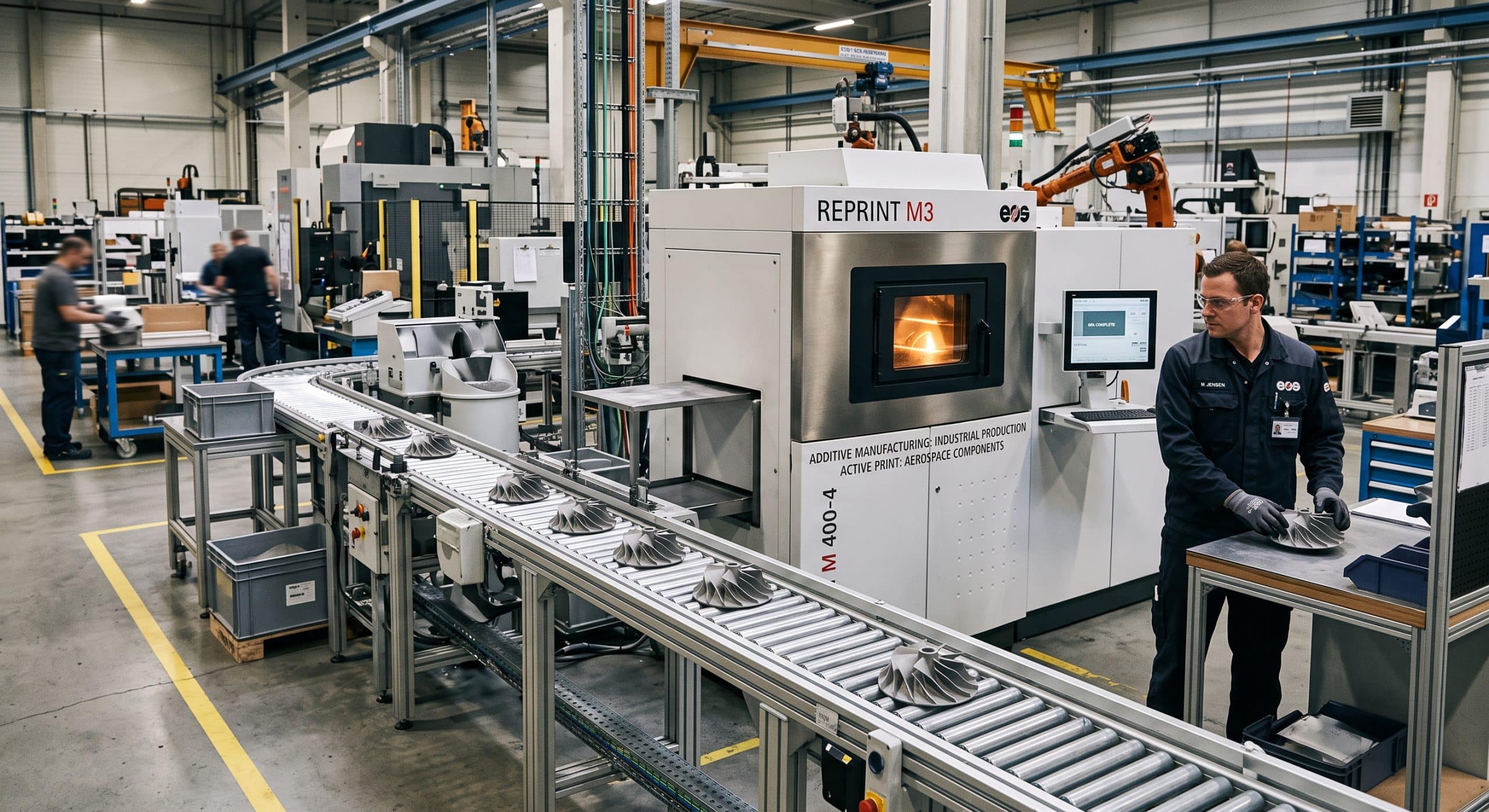
I still remember the first time a plant manager asked me, half joking, whether my printers were “toys for the engineering department.” That was years ago. We were printing prototypes, a few fixtures, and the odd replacement knob for a machine nobody made parts for anymore. The question stung, but it was fair. Back then, 3D printing lived in a corner of the building, far away from the lines that actually shipped product.
That corner has moved. Today I spend most of my week on the production floor, not in a lab. I’m talking to quality engineers about process validation, to maintenance teams about spare parts, and to purchasing about powder contracts. That shift is what I want to walk you through, because additive manufacturing in industrial production is no longer a pitch deck idea. It’s happening in plants right now, and it’s changing how people think about making things.
I’ll be straight with you, though. It isn’t happening everywhere, and it isn’t happening the way the hype of ten years ago promised. So let me give you the version I’d give a colleague over coffee: what’s real, what’s working, where it still struggles, and how I’d approach it if you were thinking about bringing it into your own operation.
From the Prototype Shop to the Production Floor
For most of its history, additive manufacturing (AM) was a prototyping tool. You designed a part, printed it overnight, held it in your hand the next morning, and then sent the final design off to be machined, cast, or molded. That alone was valuable. It cut weeks out of development cycles.
What changed is that the machines, materials, and process controls got good enough that the printed part itself could be the final part. Not a model of the part. The part.
What the Market Numbers Tell Us
The industry numbers reflect that change, even if they also show some caution. According to the Wohlers Report 2026, the global additive manufacturing market grew 10.9% in 2025 to roughly $24.2 billion. What caught my eye, though, wasn’t the headline number. It was the detail underneath. Printing services grew about 15.5% and now make up close to half the market, while new machine sales grew only around 3.6%. Companies are squeezing more hours out of the printers they already own and buying more material to feed them.
To me, that’s what production looks like. When a technology is still experimental, people buy machines to try things. When it matures, they start running those machines hard and asking about uptime, cost per part, and repeatability. Dr. Mahdi Jamshid of Wohlers Associates put it well when he said growth is now “more closely tied to real production outcomes.” That matches exactly what I see on the ground.
What “Production” Actually Means in AM
Let me clear up something that confuses a lot of people. When we say 3D printing is entering production lines, we don’t usually mean a printer sitting in the middle of an automotive assembly line spitting out body panels at line speed. That picture is mostly science fiction for now.
In my experience, additive manufacturing in industrial production shows up in four main ways:
1. End use parts in series production. These are real components that go into a shipped product, printed in batches, sometimes by the tens of thousands. Think fuel nozzles, valve bodies, brackets, heat exchangers, and medical implants.
2. Tooling, jigs, and fixtures. This is the quiet workhorse of AM. Assembly fixtures, drill guides, gauges, grippers for robot end effectors, and inserts for injection molds with conformal cooling channels. These never ship to a customer, but they make the line run better.
3. Spare parts and repair. Printing replacement parts on demand, especially for older equipment where the original supplier is gone, and using directed energy or powder bed processes to rebuild worn components instead of scrapping them.
4. Digital inventory. Storing a validated part file instead of a shelf full of parts, then printing when and where you need it.
Each of these has a different business case, a different quality bar, and different people who need to sign off. When a company tells me they want to “do AM in production,” my first question is always: which one?
The Case That Convinced the Skeptics
If you work anywhere near this field, you’ve heard about the GE fuel nozzle. I bring it up anyway because it’s still the cleanest example of why additive earns its place on a production line.
The fuel nozzle tip for the LEAP jet engine used to be about 20 separate pieces brazed and welded together. GE’s engineers tried to cast a better design and, as Mohammad Ehteshami famously said, “We tried to cast it eight times, and we failed every time.” The internal fuel passages were simply too complex.
So they printed it as a single part. The result was about 25% lighter, roughly five times more durable, and around 30% more cost effective to produce. GE’s plant in Auburn, Alabama produced its 30,000th nozzle tip in 2018 and shipped its 100,000th in 2021.
The Lesson for Everyone Else
Here’s why this matters for anyone outside aerospace. The nozzle wasn’t a success because 3D printing is cool. It succeeded because the geometry was impossible (or ridiculously expensive) to make any other way, and consolidating 20 parts into one removed assembly steps, joints, inspection points, and failure modes.
That’s the pattern I look for with every client. If your part can be machined easily from bar stock, printing it will almost always cost you more. If your part has internal channels, lattice structures, or a pile of subassemblies, now we have something to talk about.
Automotive: Where Volume Meets Reality
Automotive is a tough test for additive because the volumes are high and the margins are thin. That’s exactly why I pay close attention to it.
BMW’s Additive Manufacturing Campus
BMW Group is probably the best documented example. Their Additive Manufacturing Campus near Munich has produced around 1.6 million parts since it opened in 2020, and the group prints roughly 100,000 components a year across its vehicle plants. A good chunk of that is production aids: tools, fixtures, and gripper fingers that the plants print for themselves. BMW has also said it plans to bring Wire Arc Additive Manufacturing (WAAM) into series production from 2027 for larger metal components.
What I find most telling about BMW’s approach isn’t the headline part count. It’s that they’re pushing printing out to the individual plants so they can make their own production accessories quickly, without waiting on a toolmaker. Any line supervisor who has waited six weeks for a replacement fixture understands why that’s powerful.
John Deere and Binder Jetting
Then there’s John Deere, which worked with HP and GKN Powder Metallurgy to bring a binder jetted metal part into mass production for its tractors. Binder jetting is interesting because it’s closer in economics to traditional powder metallurgy than laser powder bed fusion is. You print a “green” part with a binding agent, then sinter it in a furnace. It’s faster and cheaper per part at volume, although you have to account for shrinkage during sintering, which takes real engineering skill to get right.
Energy and Heavy Industry: The Repair Story
Not every production win is about making new parts. Some of the most valuable work I’ve seen is in maintenance, repair, and overhaul.
Siemens Energy, working with EOS, developed a process to repair gas turbine burner tips. Instead of replacing the whole burner, they machine off the damaged section and print new material directly onto the existing component. The reported result was about a 90% reduction in repair time. As a bonus, they could upgrade older burners to the current design during the repair itself.
This is the part of the story I wish more plant managers knew about. If you run heavy equipment, pumps, turbines, or compressors, you likely have components that wear out on a predictable schedule, cost a fortune to replace, and have long lead times. Additive repair can change those economics dramatically. It’s less glamorous than printing a rocket engine, but it pays the bills.
The Technologies You’ll Actually Encounter
When people say “3D printing,” they’re lumping together very different processes. On a production floor, you’ll mostly run into the ones below.
Metal Processes
Laser Powder Bed Fusion (LPBF). A laser melts thin layers of metal powder. It’s the dominant metal process for precise, complex parts in aerospace, medical, and energy. It’s accurate but relatively slow and expensive per kilogram.
Binder Jetting. Prints a green part with a binder, then sinters it. Better suited to higher volumes of smaller metal parts. Watch out for dimensional control through sintering.
Directed Energy Deposition (DED) and WAAM. Feeds wire or powder into a melt pool created by a laser, electron beam, or arc. Great for large parts and repair work. Rougher surface finish, so plan on machining.
Polymer Processes
Polymer Powder Bed Fusion (SLS and MJF). Workhorses for polymer end use parts, ducts, housings, clips, and brackets. Good mechanical properties and no support structures needed.
Material Extrusion (FFF/FDM). The process most people picture. On the production floor, industrial versions with engineering polymers and carbon fiber are fantastic for jigs and fixtures.
Choosing the Right Process
Industry commentary heading into 2026 has noted that while LPBF still leads in metal, binder jetting, DED, and electron beam systems are gaining real traction, each in its own niche. Nikon’s Behrang Poorganji summed up the mindset shift nicely: additive “is no longer about what can be printed; it is about what can be produced, repeatedly, with confidence.” I’d frame that sentence and hang it in every AM department.
The Hard Parts Nobody Puts in the Brochure
I’d be doing you a disservice if I only told you the success stories. Here’s what actually slows down additive manufacturing in industrial production.
Qualification and Repeatability
Printing one great part is easy. Printing ten thousand identical ones, on different machines, across different powder lots, with documentation an auditor will accept, is hard. This is where most projects stall.
The good news is that the standards world has caught up considerably. ISO/ASTM 52920, published in 2023, lays out qualification requirements for industrial AM processes and production sites, going well beyond a general quality system like ISO 9001. If you’re in aerospace, automotive, rail, or medical, get familiar with it. Your customers will be asking about it, if they aren’t already.
Post Processing
People underestimate this every single time. A metal part coming off the build plate usually needs stress relief, removal from the plate, support removal, heat treatment, maybe hot isostatic pressing, machining of critical surfaces, and inspection. In my projects, post processing often accounts for a large share of total part cost and lead time. If your business case only prices the print, it’s wrong.
Design Skills
You can’t take a part designed for machining, print it, and expect magic. The value comes from redesigning for additive: consolidating assemblies, adding internal channels, removing mass where it isn’t needed. That takes engineers who think differently, and good ones are still in short supply.
Cost Per Part
For simple geometries at high volume, traditional methods still win, often by a lot. The Wohlers data showing hesitancy around new machine purchases reflects this. Capital is tighter and finance teams want clearer returns. That’s healthy, honestly. It forces us to pick the right applications instead of printing everything because we can.
How I’d Bring AM Into Your Production Line
If you asked me to help your plant get started, here’s roughly how I’d approach it. None of this is secret. It’s just what I’ve seen work.
Start Small and Low Risk
Start with tooling, not product. Jigs, fixtures, and gauges carry low risk, deliver quick wins, and teach your team the technology without putting a customer part on the line. Many plants pay for their first printer this way within months.
Audit your spare parts pain. Look for obsolete components, long lead time items, and parts that fail often. These are strong candidates for printing or additive repair.
Hunt for consolidation opportunities. Go through your assemblies and find places where five, ten, or twenty parts come together. Those are where additive shines, just like the GE nozzle.
Build the Foundation for Scale
Decide build versus buy. Given how fast service providers are growing, it often makes sense to partner with a qualified service bureau first, prove the application, and only then invest in your own equipment.
Plan qualification from day one. Decide early what standards apply, what testing you’ll need, and how you’ll control powder, parameters, and machine calibration. Retrofitting a quality system later is painful.
Invest in people. Train your designers in design for additive manufacturing. Train your technicians on post processing. The machine is the easy part.
Where This Is Headed
Looking out over the next few years, I expect a few things to continue.
Automation Around the Printer
Automation around the printer will matter more than the printer itself. Automated powder handling, depowdering, part removal, and inline inspection are what turn a printer into a production cell. Industry voices heading into 2026 have pointed toward more centralized, highly automated facilities as the way just in time manufacturing will actually scale.
A Market Splitting in Two
The market will keep splitting in two. One side chases lower cost for higher volume parts in machinery and consumer products. The other stays focused on high value, highly regulated components for aerospace, defense, energy, and medical. Both are real, but they need very different strategies.
Digital Inventory Goes Mainstream
Digital inventory will creep into more supply chains. Not overnight, and not for everything, but for slow moving spare parts it makes a lot of sense to store a qualified file instead of a warehouse full of stock.
And finally, I think the conversation will keep getting more boring, in the best possible way. When people stop asking “can we print it?” and start asking “what’s the cost per part and the Cpk?”, you know a technology has arrived on the production floor.
Final Thoughts
When that plant manager called my printers toys all those years ago, he wasn’t wrong about where the technology stood at that time. But I’d give him a very different tour today. I’d show him fixtures that cut changeover time, a repaired component that got a critical machine back online in days instead of months, and a consolidated part that eliminated a whole subassembly line.
Additive manufacturing in industrial production isn’t a replacement for machining, casting, or molding. It’s another tool in the kit, and a very powerful one when you use it for the right job. The companies getting real value from it are the ones who picked their applications carefully, took quality seriously, and invested in their people. If you do those three things, you’ll be surprised how quickly 3D printing stops being a side project and becomes part of how your plant runs.
Frequently Asked Questions
What is additive manufacturing in industrial production?
It’s the use of 3D printing processes to make end use parts, tooling, fixtures, and spare parts as part of normal manufacturing operations, rather than just for prototypes. Examples include GE’s printed fuel nozzles and BMW’s printed production aids. Learn more at BMW Group: Additive manufacturing moves ever closer to series production.
Is 3D printing actually used for mass production?
Yes, in the right applications. GE shipped its 100,000th additively manufactured fuel nozzle tip from its Auburn plant, and John Deere brought a binder jetted metal part into mass production. See 3DPrint.com on GE’s 100,000th fuel nozzle and Forbes on John Deere’s 3D printed engine parts.
How big is the additive manufacturing market?
The Wohlers Report 2026 values the global AM market at about $24.2 billion, with 10.9% growth in 2025. Read the summary at 3Dnatives: Wohlers Report 2026.
Which industries use additive manufacturing the most in production?
Aerospace, automotive, healthcare, and energy lead adoption, largely because they benefit from complex geometries, lightweighting, and part consolidation. See Design News on AM’s shift to production in 2026.
What standards apply to production additive manufacturing?
ISO/ASTM 52920:2023 sets qualification requirements for industrial AM processes and production sites. Details are at ISO/ASTM 52920:2023.
Can 3D printing be used to repair industrial parts?
Yes. Siemens Energy and EOS developed a process to repair gas turbine burner tips that cut repair time by about 90%. See EOS: Siemens turbine burner repair.
Is additive manufacturing cheaper than traditional manufacturing?
Not always. For simple parts at high volume, machining, casting, or molding usually cost less. AM wins when geometry is complex, volumes are low to medium, or it lets you consolidate many parts into one.
What’s the best way for a manufacturer to get started with AM?
Start with jigs, fixtures, and tooling, then move into spare parts and part consolidation. Partnering with a qualified service provider before buying equipment is often the smartest first step.
References
Wohlers Associates. “New Wohlers Report 2026 Values Additive Manufacturing Market at $24.2B.” wohlersassociates.com
3Dnatives. “Wohlers Report 2026: Growth Continues, But Caution Defines the AM Market.” 3dnatives.com
ASTM International. “New Wohlers Report 2026 Values Additive Manufacturing Market at $24.2B.” astm.org
GE News. “Transformation in 3D: How a Walnut Sized Part Changed the Way GE Aviation Builds Jet Engines.” ge.com
3DPrint.com. “GE Aviation Announces 100,000th 3D Printed Fuel Nozzle Shipped from Auburn Plant.” 3dprint.com
BMW Group. “Additive Manufacturing Moves Ever Closer to Series Production.” bmwgroup.com
Forbes. “John Deere Turns to 3D Printing More Efficient Engine Parts.” forbes.com
EOS GmbH. “3D Printing to Enhance Industrial Gas Turbines (Siemens Case Study).” eos.info
3DPrint.com. “3D Printing Predictions 2026: Industrial Production in Metal Additive Manufacturing.” 3dprint.com
Design News. “3D Printing Shifts from Prototyping to Production in 2026.” designnews.com
Metal AM. “New ISO/ASTM Standard for Qualification of Industrial AM Processes.” metal-am.com
ISO. “ISO/ASTM 52920:2023 Additive Manufacturing: Qualification Principles.” iso.org