
 By Robert Smith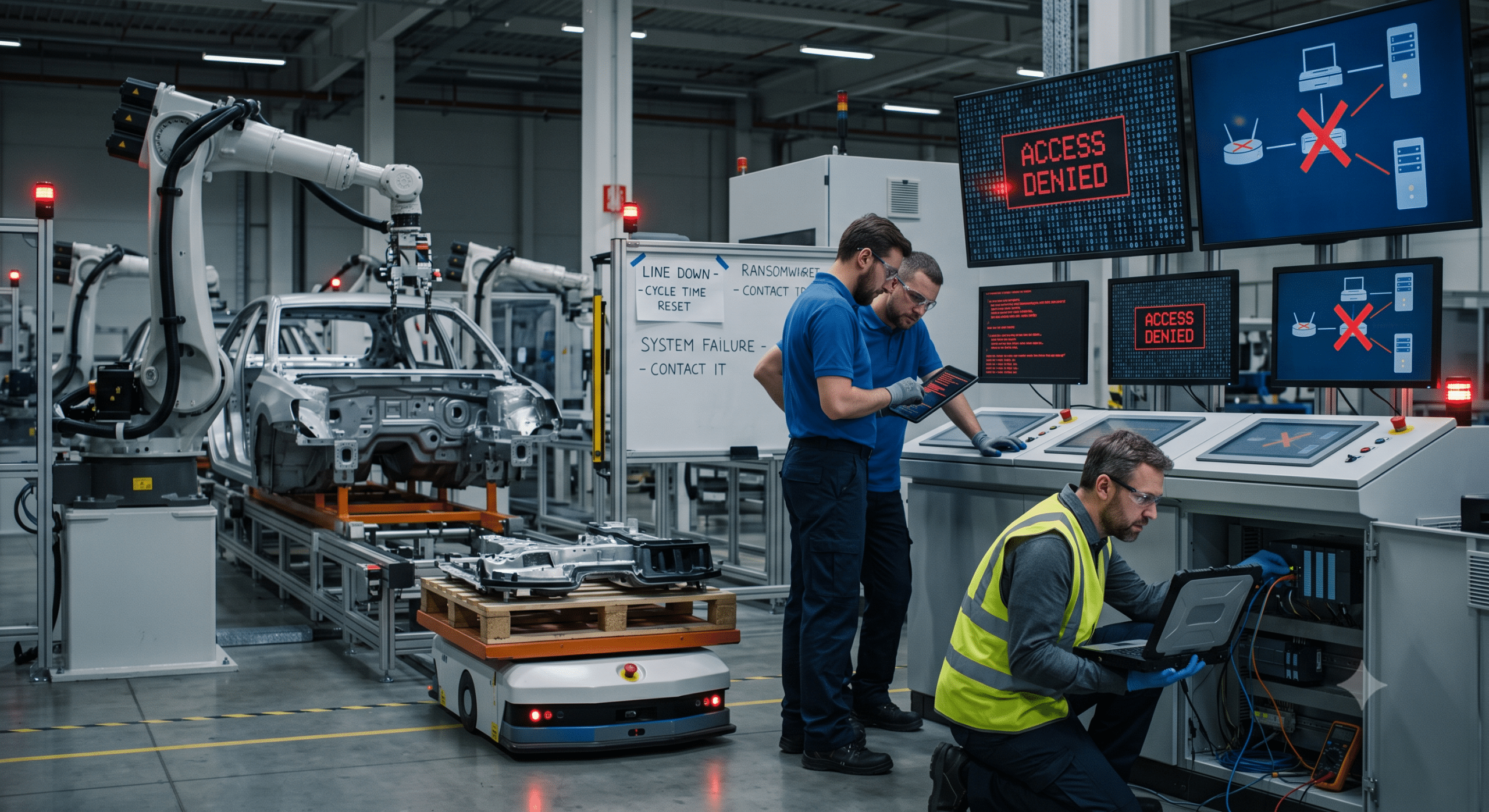
When a modern manufacturing plant suffers a cyber breach, executive leadership usually misdiagnoses the problem. Specifically, corporate suites view these threats through the lens of data privacy, regulatory penalties, or public relations damage. However, my perspective as a forensic engineer is entirely different. This is because I spend my days digging through the physical and digital wreckage of broken production lines.
Ultimately, the true devastation of a digital intrusion does not live inside an encrypted server alone. Instead, it echoes dynamically through the physical, rhythmic pulse of the factory floor. For example, it manifests directly as stalled machinery, chaotic operator workarounds, and a massive destruction of manufacturing efficiency.
Consequently, cyber incidents in manufacturing are fundamentally operational disasters disguised as software bugs. When a malicious payload infiltrates an Operational Technology (OT) network, it immediately disrupts a fragile balance. Furthermore, it directly attacks your ability to maximize throughput, keep cycle times short, and minimize material scrap rates. As a result, these digital disruptions transform highly optimized manufacturing environments into high-cost, high-waste crime scenes. By examining these failures through an engineering lens, we can clearly reveal the harsh mechanics of how a single cyber threat destabilizes physical factory ecosystems.
1. The Sudden Stoppage: How Digital Intrusions Imposed an Immediate Throughput Freeze
First of all, throughput is the ultimate lifeblood of any production facility. It measures the volume of quality products passing through a system over a specific timeframe. In a highly automated plant, this metric relies entirely on continuous data exchanges. Therefore, information must flow smoothly between the Enterprise Resource Planning system, the Manufacturing Execution System, and the physical Programmable Logic Controllers on the shop floor.
During a recent forensic analysis at an automotive component assembly plant, a ransomware payload breached the corporate network. Subsequently, the malware quickly moved laterally into the industrial environment. It systematically encrypted the production scheduling servers. Specifically, these servers told the automated guided vehicles which parts to bring to each assembly cell. Consequently, within minutes, the entire plant suffered a total throughput freeze.
Meanwhile, the multi-million-dollar assembly robots remained physically operational. Yet, they sat completely motionless because they lacked the data inputs required to initiate their cycles. As a result, the line went from producing eighty finished units per hour to absolute zero. Ultimately, this sudden operational halt highlights a critical reality in modern manufacturing environments. You simply cannot maintain physical throughput when your digital routing instructions are held hostage.
2. The Ripple Effect: Why Cycle Times Skyrocket Long After the Initial Breach is Contained
In addition to throughput drops, cycle time is a critical metric that measures the total time required to transform raw materials into a finished product. This metric applies to a single station or across the entire line. Naturally, industrial engineers balance these timelines down to the millisecond. Therefore, when a cyber incident forces an automated facility to resort to manual workarounds, these tightly tuned cycle times degrade rapidly.
For instance, a recent cyber intrusion knocked out the automated calibration systems at a precision electronics manufacturer. Following the attack, facility management decided to keep lines running by using manual overrides. Consequently, operators had to read technical specifications from printed paper binders. Then, they manually input coordinates into the machines using physical keypads.
Predictably, this operational shift completely destroyed the standard production rhythm. A process that typically took forty-five seconds per unit suddenly required over three minutes to complete. As a result, the bottleneck at the calibration station backed up upstream operations. Furthermore, it delayed downstream packaging and caused the cycle time for the entire facility to swell exponentially. In conclusion, this incident proved that even if you keep your machines moving during a breach, manual friction will balloon your cycle times beyond profitability.
3. The Quality Chaos: Hidden Scrap Rates Born from Corrupted Control Data
Beyond timing delays, scrap rate serves as a direct indicator of process control and stability. In a perfect manufacturing run, minimal raw material is wasted. However, cyber incidents in manufacturing frequently introduce subtle data corruption into the system. This corruption alters the recipe files or operating parameters stored within industrial machines, thereby leading to catastrophic spikes in material waste.
To illustrate this, consider an investigation I conducted at a specialized chemical processing plant. A threat actor gained unauthorized access to an industrial workstation. Subsequently, they subtly altered the thermal profile parameters inside a curing oven’s control loop. Surprisingly, the system did not crash, nor did it trigger an emergency stop alarm. Instead, it quietly baked expensive composite components at $5^\circ\text{C}$ below the required target temperature.
Meanwhile, the digital quality-assurance dashboards were also compromised. Because of this, the operators missed the temperature anomaly completely for twelve consecutive production hours. When the laboratory team eventually ran a physical destructive test on the finished goods, they discovered that workers had produced thousands of structurally flawed units. Consequently, the company had to scrap the entire batch. This resulted in hundreds of thousands of dollars in wasted raw material and a severe blow to the facility’s monthly yield.
4. The Blind Spot: The Breakdown of Real-Time Industrial Monitoring Systems
Equally important is the fact that modern manufacturing efficiency relies entirely on complete visibility. Supervisors depend heavily on real-time telemetry from Supervisory Control and Data Acquisition systems. This data allows them to identify micro-stoppages, track overall equipment effectiveness, and adjust line speeds on the fly. Thus, when a cyber incident blinds these monitoring platforms, plant management loses its ability to control the floor.
For example, I recently conducted a forensic review at a high-speed bottling facility. A distributed denial-of-service attack flooded the internal plant network with junk data traffic. However, the main consequence was not a mechanical machine breakdown. Instead, the plant suffered a total loss of sensor communications from the field devices back to the central control room.
As a result, operators ran high-speed packaging lines completely blind. Specifically, they could not see if a jam had occurred at the labeling station, nor could they tell if a conveyor belt was slipping. Lacking real-time telemetry, supervisors subsequently slowed down the main line by 50% to prevent catastrophic pile-ups. Therefore, this reduction in visibility instantly restricted the plant’s throughput, lengthened cycle times, and illustrated that a lack of operational data is just as damaging as a broken mechanical part.
5. The Calibration Nightmare: Restoring Machine Integrity After Unauthorized Access
Furthermore, when a cyber incident compromises an industrial system, recovery requires a deep technical effort. The process involves much more than just removing malware and restoring server backups. From a failure analysis perspective, hackers touch physical hardware. Every piece of automated asset handled by an unauthorized entity requires extensive testing as an uncalibrated and potentially unsafe unit.
At a precision medical device manufacturing plant, a sophisticated cyber attack targeted specific machine components. Specifically, the hackers altered the firmware of multi-axis CNC machines used to mill orthopedic implants. Once the security team successfully isolated the digital threat, the operations team faced the daunting task of verifying the mechanical integrity of every asset.
Consequently, engineers took every single machine offline. Workers wiped the systems, reflashed them with certified firmware, and meticulously recalibrated them using physical touch probes and laser interferometers. Ultimately, this exhaustive recalibration process took the facility out of commission for nine straight days. The total stoppage pushed cycle times for pending customer orders from a two-week turnaround to over a month, while throughput dropped to absolute zero during the maintenance window.
6. The Supply Chain Cascade: Just-In-Time Inventory Collapse
In addition to internal systems, the manufacturing world heavily relies on Just-In-Time logistics. Raw materials arrive at the loading dock exactly when the assembly line needs them. Ideally, this strategy minimizes warehousing costs and keeps inventory cycle times lean. However, when a cyber incident strikes an integrated supplier network, this delicate balance collapses instantly.
A prominent consumer electronics assembler experienced this operational reality firsthand. A ransomware strain completely crippled their logistics portal. As a result, the system stopped transmitting real-time consumption data to upstream component suppliers. Consequently, the delivery of specialized microprocessors ground to a halt.
Within twenty-four hours, the assembler ran completely out of safety stock. The main assembly line originally produced thousands of devices per shift; instead, it sat completely idle. Therefore, this incident demonstrated how an isolated cyber event can ripple outward. It starves an entire facility of components, drives cycle times to a complete standstill, and severely caps regional throughput.
7. The Human Element: Training Decay and Operator Fatigue in Crisis Mode
Another critical factor to consider is the human element. When automation fails due to a digital crisis, human operators must step in to fill the operational gaps manually. However, humans are not programmable systems. On the contrary, they suffer from fatigue, stress, and cognitive overload when forced into unfamiliar manual routines.
I discovered a clear example of this during a post-mortem analysis at a heavy equipment foundry. A cyber attack knocked out the automated pouring controls for molten metal. Consequently, plant managers decided to utilize manual pouring methods to maintain minimum throughput targets.
However, the operators had spent years monitoring automated interfaces rather than physically handling heavy pouring ladles. Because of this, the workers quickly became exhausted over their twelve-hour shifts. This physical fatigue led to inconsistent pouring speeds and improper mold filling. Although the manual intervention managed to salvage a small fraction of the plant’s daily throughput, it simultaneously triggered a 15% increase in casting defects, which caused the scrap rate to surge to historic highs.
8. The Legacy Asset Vulnerability: The Danger of Unpatched Operational Hardware
Dealing with legacy equipment remains one of the greatest challenges in industrial forensic engineering. Many manufacturing plants run massive, expensive machines built decades ago. Mechanically, these machines remain perfectly functional. However, they run on obsolete operating systems that are highly vulnerable to modern digital threats.
For instance, I was brought in to investigate a major failure at a textile manufacturing plant. A legacy weaving loom controller ran an unpatched version of Windows XP from the early 2000s. Suddenly, an automated worm network infected this unprotected asset. The worm subsequently caused the controller to send erratic speed commands to the loom’s servo drives.
As a direct result, the sudden change in speed tore the raw fabric strands apart. This mechanical failure created massive snarls inside the machinery. Clearing the tangled material required hours of intense manual labor. Furthermore, the workers discarded the ruined textiles immediately. This incident proved that running unpatched legacy assets alongside modern networked systems is a major operational risk. Ultimately, it directly threatens your scrap rate and your overall throughput.
9. The Recovery Bottleneck: The High Cost of Staged Line Restarts
Finally, when a major cyber incident is resolved, you cannot simply flip a master switch and expect the factory floor to return to full capacity instantly. Recommissioning a complex, interconnected manufacturing facility requires a methodical, staged approach. This careful process is necessary to prevent severe electrical surges, mechanical collisions, and immediate quality failures.
To illustrate, a high-volume food processing plant recently suffered a security breach. Restarting the facility required verifying the cleanliness and synchronization of over three miles of conveyor systems, cooking ovens, and packaging cells. If the packaging lines went online before the cooking ovens reached their target temperature, thousands of pounds of raw food would bypass the thermal step. Consequently, this error would create an immediate biological hazard, forcing the team to dump the entire batch into the scrap bin.
Therefore, the staged restart process alone took three full days of careful, step-by-step balancing. During this ramp-up phase, the plant’s cycle times swelled, and throughput remained severely limited. In conclusion, this case illustrates that the tail end of a cyber incident recovery can be just as costly as the initial shutdown.
Expert Recommendations for Modern Manufacturing Resilience
To safeguard industrial environments against digital disruptions that target operational metrics, engineering and security teams must implement proactive, floor-centric defense strategies:
-
Enforce Strict Network Segmentation: Isolate critical Operational Technology networks from corporate IT infrastructures. Use industrial firewalls and strict demilitarized zones to halt the lateral movement of malware.
-
Establish Validated Manual Operating Procedures: Develop and regularly audit comprehensive manual operation playbooks. This allows operators to maintain minimum throughput safely without causing massive scrap spikes during an automation outage.
-
Implement Immutable Offsite Backups: Keep secure, offline copies of all machine configurations, PLC ladder logic, and product recipe files. This ensures rapid restoration of machine calibration and minimizes line restart delays.
Frequently Asked Questions
How exactly does a cyber incident directly cause an increase in physical scrap rates?
When a cyber incident alters the operational parameters or recipe files within a machine’s controller, the hardware may run at incorrect temperatures, pressures, or speeds. This subtle data corruption causes the machinery to produce defective goods that fail quality inspections, leading to immediate spikes in material waste and scrap.
Why can’t a plant return to full throughput immediately after a cyber threat is cleared?
Industrial lines are complex, tightly synchronized systems. Bringing a facility back online requires a staged restart process to verify safety protocols, re-confirm machine calibrations, and ensure all subsystems are perfectly timed. Attempting a rapid, uncoordinated restart can cause physical equipment damage, personnel hazards, and immediate quality defects.
What makes legacy manufacturing equipment so vulnerable to modern cyber attacks?
Many legacy industrial machines rely on old operating systems that lack modern security features and no longer receive software updates. When these old systems are connected to modern, internet-facing corporate networks without proper isolation, they become easy targets for automated malware and lateral network intrusions.
References and Further Reading
For a deeper look into industrial cybersecurity benchmarks and detailed case studies on how operational technology environments are impacted by modern digital threats, explore the following industry analysis resources: