
 By Robert Smith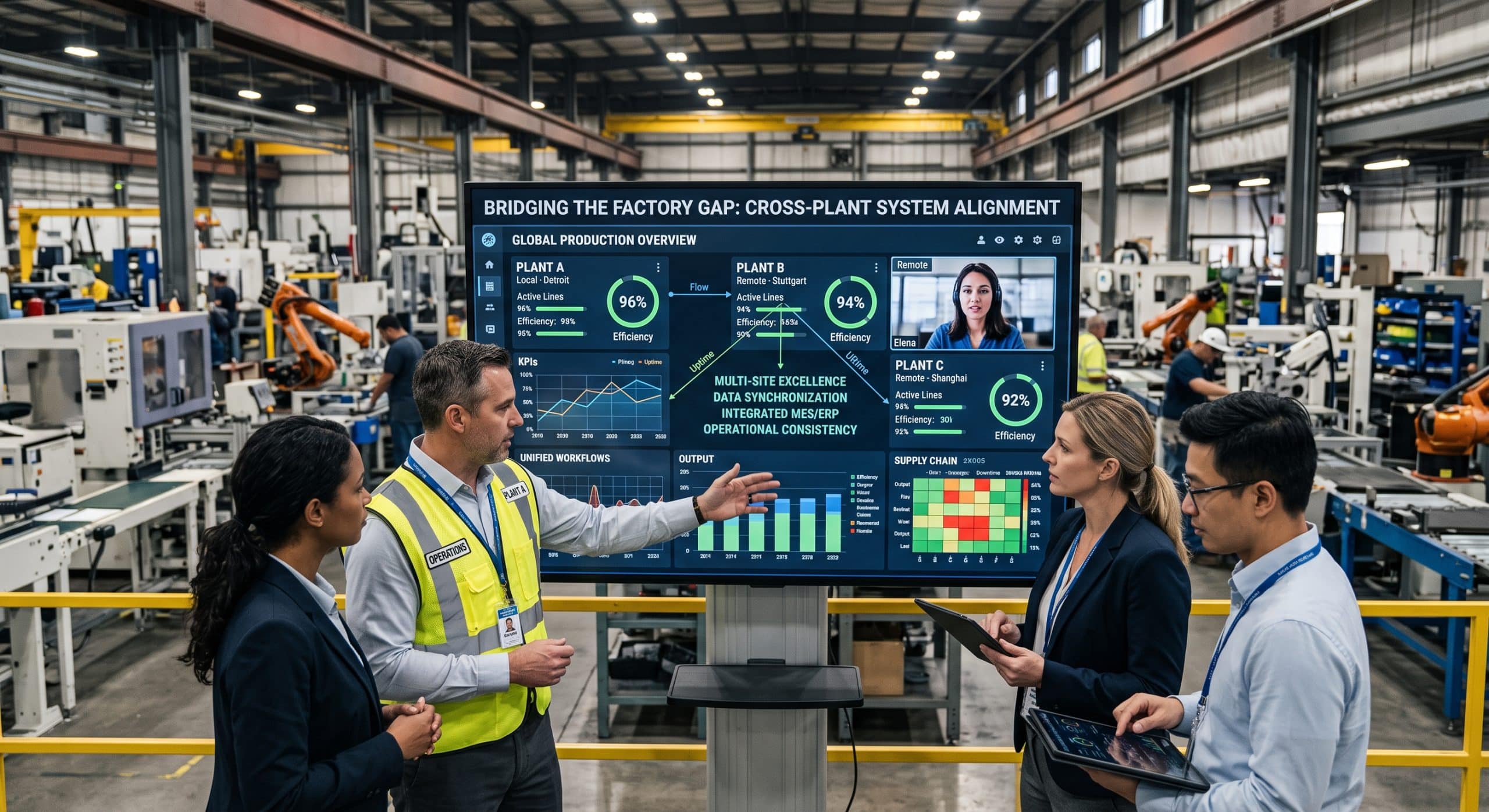
I still remember the exact moment I realized we had a problem. Six weeks after closing an acquisition, I asked a simple question in a leadership review: “What’s our average changeover time across the network?” I got four different answers from four different plant managers. Each number came from a different system, using a different definition, and none of them communicated. That was the day I realized our newly combined company wasn’t operating as one manufacturer, but as six separate plants wearing the same logo. Solving this required cross-plant system alignment—a structured approach to standardizing operations, data structures, and technologies across every site in our network.
If you’ve lived through an industrial merger or a multi-site expansion, you already know this story. So does anyone who’s watched years of organic growth leave every plant to build its own tech stack. It’s not really a technology problem, even though it looks like one. It’s an alignment problem. And it has a name that rarely gets enough attention in board decks and integration plans: cross-plant system alignment.
This piece lays out what cross-plant system alignment actually requires. I’ll cover why it becomes non-negotiable during industrial mergers. And I’ll show how operations leaders can pull it off without grinding their plants to a halt in the process.
What Cross-Plant System Alignment Actually Means
Cross-plant system alignment is the discipline of making sure your plants run on shared data structures, common processes, and compatible systems. A number should mean the same thing no matter which plant reports it. That doesn’t mean every plant runs identical software with zero flexibility. I’ve never seen that work, and I’d be suspicious of anyone who claims it does. What it does mean is that the core layers, your ERP, your MES, your quality records, your maintenance data, sit on a shared foundation. Local configuration only kicks in where the business genuinely needs it.
Think about what happens without that foundation. One plant calls a defect a “reject.” Another calls it a “scrap unit.” A third logs it as a “non-conformance,” using a completely different root-cause taxonomy. Roll those three data sets into one corporate quality dashboard and you don’t get insight. You get noise dressed up as a chart. Now multiply that pattern across inventory codes, routing steps, downtime reasons, and safety incident categories. You end up with an operation that looks unified on an org chart. On the shop floor, it behaves like six separate businesses.
Why Industrial Mergers Make This Urgent
Mergers and acquisitions compress a problem that might otherwise develop slowly over a decade into something you have to solve in months. When two manufacturers combine, you’re not just merging balance sheets. You’re merging two entirely different sets of assumptions about how work gets done, along with two entirely different software ecosystems built to support those assumptions.
A Track Record That Should Worry Every Integration Team
Most M&A deals never deliver the value they promised on paper. Research on post-merger performance has repeatedly shown that a large majority of deals fall short of the return projections used to justify them. In manufacturing specifically, a lot of that shortfall traces straight back to operational fragmentation that never got fixed. Leadership announces the deal. Finance closes it. Operations then spends six months building “temporary” workarounds, and those workarounds quietly become permanent because nobody wants to interrupt production to fix them properly.
I’ve sat in enough integration steering committees to know the pattern. Legal and finance integration gets a detailed 100-day plan. IT gets a mandate to “connect the systems.” Operations gets a note in the appendix. That ordering is backwards. If your plants can’t share a common operating picture, you can’t actually manage the combined company. You can only manage two companies that happen to share a logo and a quarterly earnings call.
The Timing Trap Nobody Warns You About
There’s also a timing trap worth naming directly. In the first months after a deal closes, everyone focuses on keeping the lights on and retaining key people. Hitting the numbers the deal thesis promised takes priority too. System alignment feels like it can wait, and in the narrowest sense, it can. Plants can keep running on separate systems for a while without anything catching fire. The problem is that “for a while” has a way of becoming three years. By then, the two organizations have grown further apart, not closer together, and the cost of aligning them has grown right along with the delay.
The Six Systems That Have to Talk to Each Other
When I map out an alignment program, I start by naming the systems that matter most. These are the systems that determine whether a plant can be compared, benchmarked, and managed alongside its sister sites. In my experience, six categories matter more than any others.
First, the enterprise resource planning platform governs orders, inventory, and financials. Second, the manufacturing execution system captures what’s actually happening on the line in real time. Third, quality management covers inspection records, non-conformances, and corrective actions. Fourth, asset and maintenance management tracks equipment history, work orders, and reliability data. Fifth, the data historian or SCADA layer captures machine-level process data. Sixth, supply chain and production planning tools schedule materials and capacity across the network.
Align those six, or at least align them at the data-definition level even where the underlying software differs, and almost everything else becomes solvable. Leave any one of them fragmented, and you’ve built a structural gap that no amount of dashboarding or reporting software will fix. I’ve watched companies spend heavily on a fancy analytics layer sitting on top of six inconsistent data sources. They expected the analytics tool to somehow reconcile definitions the underlying systems never agreed on. It never works. Garbage in, six different flavors of garbage out.
What This Looks Like When Companies Get It Right
It helps to look at how larger manufacturers have actually approached this, because the pattern shows up consistently once you know what to look for. One global industrial gas company runs roughly 350 plants and close to 48,000 employees. It standardized its data historian software across every site before it touched its manufacturing execution system rollout. That ordering wasn’t an accident. Leadership there understood something important. Layering a new execution system on top of inconsistent historian data would just push the fragmentation one level up the stack instead of fixing it.
A large connector and sensor manufacturer running nearly a hundred plants worldwide took a different but related approach. Rather than mandating a single piece of software everywhere, it settled on two standard platforms. It built a template designed to cover roughly eighty percent of what any plant needed straight out of the box. The rest stayed open for local configuration. That eighty-percent figure isn’t a coincidence. It shows up again and again across successful programs. That’s roughly the line where standardization stops fighting real operational differences and starts fighting habit instead.
A well-known global beverage manufacturer standardized its control architecture across around seventy facilities. That example is a useful reminder that this work isn’t limited to companies that just merged. Organic growth creates the same fragmentation over time, just more slowly, which is exactly why it’s easier to ignore until the gap becomes expensive.
The Hidden Cost of Letting Plants Run Their Own Way
There’s a version of this conversation where a plant manager pushes back: “our plant is different, we need our own way of doing things.” I take that seriously. Plants really are different. A high-mix, low-volume facility and a dedicated single-product line genuinely need different configurations in places. But there’s a real difference between legitimate local variation and unmanaged drift. Most organizations never draw that line clearly enough to know which one they’re looking at.
The cost of unmanaged drift rarely shows up on a single line item, which is exactly why it survives so long. Extra headcount spends its time reconciling spreadsheets before a monthly business review. A corporate quality team can’t actually compare defect rates across plants, because the categories don’t match. Moving a product between two plants should take weeks. Instead it takes months, because the receiving plant’s systems can’t ingest the sending plant’s specifications without manual translation. A new ERP rollout that should take four months at each site instead takes fourteen, because every plant insists its historical customizations are irreplaceable.
None of these costs get their own line in the budget. They hide inside “administrative overhead” and “project delays” and “the way things are here.” That’s precisely what makes them dangerous. And that’s precisely why fixing cross-plant system alignment tends to pay for itself faster than almost any other operational investment I’ve championed.
The Technical Backbone That Makes Alignment Possible
None of this works without agreement on standards at the process level, and this is where a lot of well-intentioned programs quietly stall. Industrial standards like ISA-95 and ISA-88 give manufacturers a shared vocabulary. They describe equipment hierarchies, production processes, and the boundary between business systems and control systems. You don’t need to become an expert in the standard itself. Your alignment program does need someone who understands it well enough to keep every plant’s implementation tied back to the same reference model.
Master data governance deserves its own mention here, because deadline pressure tends to push it aside first. A part number, a work center, a supplier code, a routing step: each one needs a clear owner and a clear change-control process. Without that, every plant quietly drifts back toward its own conventions within a year or two, even after a successful system rollout. I watched this happen at a plant that had completed a full ERP standardization. Local super-users started creating “temporary” part numbers within eighteen months. Nobody owned the master data after the project team moved on to the next site.
Architecture flexibility matters too. Cloud-based historians, containerized MES deployments, and modern integration platforms make this far easier than it was ten years ago. You can run a common core with local extensions instead of forcing every plant onto one rigid, monolithic system. That flexibility offers a genuine advantage, but only when a governed template puts it to deliberate use. Otherwise every plant just builds its own version of “flexible,” and that version usually means “different.”
A Practical Framework for Getting There
I won’t pretend there’s a shortcut. There is, however, a sequence that consistently beats the alternative. The alternative is usually a mandate from corporate IT that lands on plant floors with no context and gets quietly resisted for two years.
Build Governance Before You Touch a Single System
Start by standing up a small governing group, sometimes known as a center of excellence. Give it real authority to make decisions and real accountability for outcomes. This group defines what “core” means for each system. It decides where local variation is actually justified. And it holds the line when a plant manager asks for an exception that’s really just resistance to change wearing a business-case costume.
Next, build a template rather than a mandate. The best programs I’ve been part of aimed for a standard template covering roughly eighty percent of what any given plant needs out of the box. The remaining slice stayed open for genuine local configuration. That ratio matters. Push for a hundred percent standardization and you’ll get open revolt from plants with legitimate constraints. Cap it much lower than eighty and you haven’t really aligned anything. You’ve just built a slightly nicer set of separate systems.
Choose Your Pilot Site With Care
Pick your pilot site deliberately. Don’t choose your best-performing plant, because success there won’t prove much. Don’t choose your worst-performing plant either, because you’ll spend all your energy on unrelated fires. Choose a mid-performing site with a plant manager who’s genuinely bought in. Run the template there. Learn from what breaks, and only then scale. Expect the first site to take longer than you’d like. That’s not a failure of the plan. It’s the plan working, because every fix you make there saves you from making the same fix five more times at the next five sites.
Finally, treat change management as equal in weight to the technical build. Every plant has people who built their entire workflow around the current system, sometimes over fifteen or twenty years. You’re not just changing software. You’re asking someone to unlearn habits that have defined their job. Skip the training, skip the local champions, and skip the honest conversation about why this is happening. The technical rollout will succeed on paper, and the plant will quietly revert to spreadsheets within six months.
What I’d Do Differently Next Time
I’d sequence data before software. On more than one project, we picked the platform first and treated data cleanup as a workstream that would happen “in parallel.” It never really does. You end up migrating bad definitions into a shiny new system. That’s worse than leaving them in the old one, because now the bad data has a more convincing interface.
I’d also insist on a single executive sponsor with the authority to overrule plant-level pushback. Without one, every disagreement escalates slowly and every delay ends up blamed on someone else. And I’d build the business case around specific, measurable friction points rather than a general appeal to “standardization.” A plant manager will fight an abstract mandate far harder than a concrete fix to a problem they already feel every week.
Measuring Whether It’s Actually Working
You’ll know cross-plant system alignment is taking hold when a handful of things start happening naturally. Corporate reviews stop opening with an argument about whose numbers are right. A plant can discover a best practice, and another plant can adopt it within weeks rather than quarters. That’s possible because the underlying systems already speak the same language.
The Signs That Tell You It’s Working
New acquisitions onboard onto the template in months instead of years. Your operations leadership can finally answer the question I faced six weeks after that acquisition closed. They can answer it with one number, sourced the same way, from every plant in the network.
None of this happens by accident, and none of it happens quickly. Alignment is also never really finished. New products launch, new equipment arrives, and new plants join the network. Every one of those events puts a little pressure back on the standards you worked so hard to establish. The governing group that got the program off the ground in year one needs to stick around in year three and year five. Not as a project team, but as a standing part of how the business runs. It should review exceptions, retire outdated templates, and make sure the eighty-percent core doesn’t quietly erode back down to sixty.
Industrial mergers keep reshaping who owns which plants. Multi-site manufacturers face constant pressure to prove they’re actually one company rather than a holding company for several smaller ones. Against that backdrop, cross-plant system alignment has stopped being a nice-to-have IT initiative. It’s become one of the clearest levers operations leadership has for turning a collection of plants into an actual operating system for the business. The plants that get this right don’t necessarily have better equipment or cheaper labor than the ones that don’t. Their leadership simply decided a shared foundation was worth building deliberately, instead of hoping it would show up on its own.
Frequently Asked Questions
What is cross-plant system alignment?
It’s the practice of standardizing core data definitions, processes, and systems, such as ERP, MES, quality, and maintenance platforms, across multiple manufacturing sites. Trustworthy, comparable performance data across the whole network is the payoff. GE Vernova’s overview of enterprise standardization in manufacturing is a good starting reference for how this plays out in practice.
Why does this matter so much during a merger or acquisition?
A merger forces two separate operating models together on a tight timeline. Unresolved system fragmentation is one of the biggest reasons manufacturing M&A deals fall short of the financial returns their deal teams projected. The IMAA Institute’s perspectives on merger integration covers this pattern in more depth.
How standardized should plants actually be?
Most successful programs aim for a common template covering around 70 to 80 percent of requirements. The remainder stays open for legitimate local variation. Industry coverage of multi-site MES standardization strategy walks through this ratio in detail.
What usually goes wrong in these programs?
Skipping governance, standardizing software before cleaning up the underlying data, and underinvesting in change management cause most of the failures I see. Automation World’s reporting on MES harmonization after a merger documents several real examples of both the pitfalls and the fixes.
How long does a full alignment program take?
It depends heavily on the number of sites and how divergent they are today. Still, a phased rollout that starts with one pilot site and expands in waves beats attempting a simultaneous, network-wide cutover almost every time.
References
- GE Vernova, “Enterprise Standardization to Improve Manufacturing Operations”: https://www.gevernova.com/software/blog/enterprise-standardization-manufacturing-operations
- Supply & Demand Chain Executive, “Standardizing Manufacturing Operations Across Multiple Sites”: https://www.sdcexec.com/software-technology/software-solutions/article/22949181/critical-manufacturing-standardizing-manufacturing-operations-across-multiple-sites
- Automation World, “MES After the Merger”: https://www.automationworld.com/products/software/article/13307015/mes-after-the-merger
- IMAA – Institute for Mergers, Acquisitions, and Alliances, “Perspectives on Merger Integration”: https://imaa-institute.org/publications/perspectives-on-merger-integration/
- Umbrex, “Post-Merger Manufacturing Integration”: https://umbrex.com/resources/manufacturing-execution-system-playbook/post-merger-manufacturing-integration/
- Sysgenpro, “Manufacturing ERP Process Harmonization to Reduce Variability Across Plants and Teams”: https://sysgenpro.com/manufacturing-erp-process-harmonization-to-reduce-variability-across-plants-and-teams