
 By Robert Smith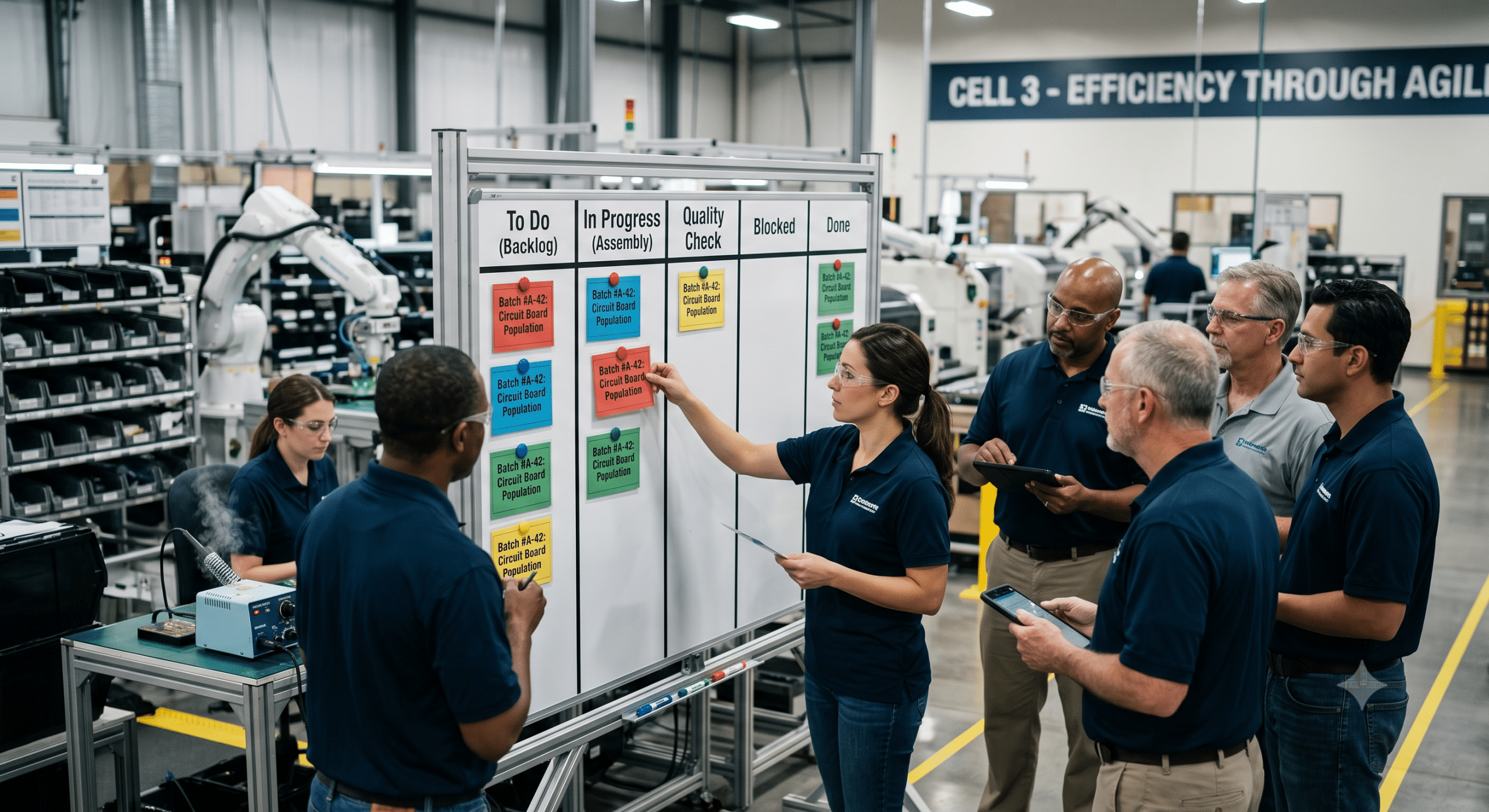
When managing heavy industrial project systems, using Agile in Manufacturing is the single best way to maximize shop floor throughput, slash your production cycle times, and keep your scrap rates remarkably low. In the manufacturing world, we used to think everything had to be set in stone before a single machine turned on. The traditional way of doing things—often called the waterfall model—meant spending months planning every little detail. We assumed that because factory gear is heavy and expensive, we couldn’t change our minds once production started.
But if you run a modern shop floor, you know that rigid plans can backfire fast. When material costs jump, customer demands change overnight, or a parts shipment gets delayed, a frozen plan causes immediate chaos. Everything grinds to a halt, parts pile up, and the scrap bin fills to the brim.
That is why forward-thinking plants are changing the rules. They are borrowing a page from the software industry to make their physical factory floors highly flexible. By looking at your plant through three simple goals—speeding up total output, cutting down production time, and stopping waste before it happens—you can transform your entire operation. Here are twelve practical shifts that can help you throw out outdated habits and build a faster, more responsive factory floor.
1. Break Big Engineering Tasks Down Into Short Team Sprints
In old-school factories, departments rarely talk to each other until it is too late. Engineering designs a part, procurement buys the materials, and the assembly team gets stuck trying to put it together. If the assembly team finds a design flaw, everything stops. The project has to go all the way back to the drawing board, which ruins your schedule.
An agile system fixes this by creating small, mixed teams. You put a product designer, a tooling expert, a buyer, and an assembly leader in the same room right from the start. Instead of waiting months for a massive product launch, the team works in quick, two-week bursts called sprints.
During these two weeks, the team focuses on building and testing just one small part of the project. If a part does not fit quite right, the assembly leader can tell the designer immediately. Catching a mistake early means you do not have to scrap thousands of finished parts later, keeping production moving forward without a hitch.
2. Ditch the Rigid Annual Plan for a Flexible To-Do List
Many factories are still ruled by a strict yearly calendar. While having a long-term plan feels safe, it rarely survives real-world problems like supply chain delays or sudden order changes. Forcing your team to follow an outdated schedule leads to making items nobody wants while the orders you actually need sit in a queue.
With agile, you replace that rigid schedule with a living, breathing to-do list called a product backlog. The plant manager and shift supervisors look at this list every single week to adjust priorities based on what is actually happening in the market and what materials are currently sitting in the warehouse.
If a critical component is stuck on a shipping boat, you do not let your workers sit idle. You simply look at the backlog and pull the next high-priority job that has all its parts ready to go. This keeps the factory floor constantly busy making things that actually bring in money.
3. Use Modular Setups and Quick-Change Tools
When a production line is set up to make only one specific product, you run into trouble when demand drops. Tearing down a line and rebuilding it for a different product can take days. Because changeovers take so long, managers tend to run massive batches of the same item just to justify the downtime, which clogs up the warehouse.
To be truly agile, your physical machines need to be modular. This means designing your assembly lines around standard base units with parts that can be swapped out easily. It is all about applying quick-changeover methods on the shop floor.
Using universal mounts, quick-connect hoses, and automated calibrations can reduce an eight-hour teardown to a fifteen-minute swap. When switching between products is that fast, you can run smaller, custom batches without losing time. This slashes your total production cycle time and keeps your output high.
4. Set Strict Limits on Work-in-Progress Using Visual Boards
One of the biggest hidden money pits in a factory is uncompleted work piling up between stations. If one fast machine pumps out parts faster than the next station can handle them, you end up with stacks of half-finished inventory everywhere. This clutter blocks walking paths, ties up cash, and hides quality mistakes.
Agile plants stop this by using a simple visual system called Kanban. You use physical or digital boards to track exactly where every batch of parts is on the floor. Most importantly, you place a strict cap on the number of jobs allowed at any single station at one time.
A worker cannot start a new job until the next station down the line is ready to take it. If a station hits its limit, production stops, and team members pitch in to help clear the bottleneck downstream. This keeps the flow of goods smooth and steady from start to finish.
5. Swap Long Monthly Meetings for Brief Daily Stand-Ups
Waiting until the end of a six-month project to talk about what went wrong is an expensive mistake. By then, the root causes of machine breakdowns or high scrap rates are long forgotten, and the same costly errors are bound to happen again on the next run.
Agile manufacturing brings feedback right to the shop floor with a daily fifteen-minute meeting called a huddle. Every morning, the team gathers right by the machines. Because everyone stays standing, the meeting stays short, fast, and focused on the day ahead.
Each person quickly shares what they finished yesterday, what they are tackling today, and if anything is blocking their progress. If an operator mentions that a machine is losing its calibration, a mechanic can look at it immediately. Fixing small issues right away keeps the line running and protects your daily output.
6. Let Operators Stop the Line to Fix Flaws Instantly
In a top-down management style, workers are told to keep their heads down and just follow orders. If an operator notices a slight defect, they often have to wait for a supervisor to come over and give permission to pause the machine. While waiting for approval, the machine keeps running, creating piles of useless scrap.
True agility means giving your front-line operators the power to make decisions. This is supported by an approach called edge defect mitigation, often using a warning light system known as an Andon cord. If an operator or a sensor sees a quality issue, the operator has the authority to hit the stop button immediately.
Stopping the line right away ensures that bad parts do not move down the line and ruin the rest of the assembly. The team gathers at the station immediately to fix the root cause. This quick action keeps your scrap rate remarkably low and saves your team from doing costly rework later.
7. Arrange Machines in Smart Work Cells for Better Flow
The layout of an old-school factory can look like a maze. Raw materials travel miles back and forth between isolated departments—moving from cutting to welding, then across the building to painting, and back to assembly. All this moving around takes time, risks damaging parts, and makes it hard to see the true status of an order.
Agile project managers solve this by organizing the floor into self-contained manufacturing cells. Instead of grouping similar machines together in distant departments, you arrange all the tools needed to build a specific product family in a tight, logical sequence, often in a U-shape.
This layout minimizes the distance a part has to travel. As soon as a worker finishes their step, the part moves instantly to the next tool. Because everything is close together, any defect is noticed right away by the next person in line, keeping the process clean, fast, and highly efficient.
8. Watch Live Machine Data Instead of Old Weekly Reports
Trying to run a modern factory with last week’s reports is like driving a car by only looking in your rearview mirror. By the time you read a weekly spreadsheet, the bottleneck happened days ago, and you have already lost time and money.
Agile systems eliminate this lag by using smart sensors and connected devices on the machines, often called the Industrial Internet of Things. These sensors stream live data directly to simple dashboards that managers can check on their phones or computers at any moment.
Seeing live data changes how you run your shift. If a machine’s output drops by even ten percent, the system highlights it in red, alerting the maintenance team instantly. Catching small slowdowns before they turn into major breakdowns keeps your factory running at top speed.
9. Catch Mistakes Early with Checkpoints Throughout the Line
In traditional manufacturing, quality control usually happens at the very end of the line. If a part was drilled incorrectly during step one, no one notices until the product is fully built. By then, the factory has already wasted hours of labor and expensive materials on a piece of junk.
An agile system prevents this waste by placing quality gates throughout the production process. Instead of checking parts only at the end, you use automated sensors, cameras, or quick manual checks right inside the work cells after major steps.
These quality gates catch bad parts immediately. If a component fails a check, it is flagged on the spot so it can be fixed or tossed before any more time is wasted on it. This systematic checking keeps your scrap rate low and ensures only good products move forward.
10. Cross-Train Your Team to Beat Labor Shortages
When only one specific person knows how to run a complex machine, your entire factory has a single point of failure. If that specialist calls in sick or gets pulled away to fix an emergency, that workstation shuts down, and the rest of the plant bogs down waiting for them.
Agile manufacturing beats this problem by building a cross-trained workforce. Managers use a simple skills matrix board to track what skills team members have and where they need more training. The goal is to make sure at least two or three people can run every critical station on the floor.
Cross-training gives you incredible flexibility. If an unexpected rush of orders hits the packaging area, you can temporarily move a cross-trained worker from a quiet station to help clear the logjam. This keeps production flowing and prevents costly downtime.
11. Connect Directly with Suppliers to Order Materials as You Need Them
Running out of materials can stall a factory fast. Traditional systems rely heavily on long-range forecasts, which often lead to ordering massive bulk shipments. You end up with a warehouse packed with parts you do not need, while completely running out of the one specific component required to finish today’s job.
Agile operations avoid this mess by connecting their inventory systems directly with their suppliers. When a worker uses a box of parts on the line, an automated system tells the vendor right away, triggering a small replenishment shipment.
This pull-based supply chain keeps parts arriving in smaller, frequent deliveries that match your actual daily output. You save massive amounts of warehouse space, keep your cash flow free, and ensure your team always has the exact materials they need to keep production moving.
12. Test Designs Fast with Prototypes Before Making Final Tools
Launching a new industrial product the old way can be nerve-wracking. Companies spend large sums of money on permanent steel molds and heavy stamping tools based entirely on computer drawings. If you discover a functional flaw during final testing, fixing that heavy tooling can cost a fortune and delay your launch for months.
Agile manufacturing handles this risk by using quick design loops before building permanent tools. The team uses 3D printing, simple temporary materials, and computer simulations to build working models of the product fast.
The team tests these prototypes immediately to see how they handle stress and how easily they can be assembled. Finding an error on a 3D-printed part lets engineers tweak the design on a computer screen for free. This upfront testing ensures that when you finally commit to hard tooling, the process runs perfectly on day one.
Agile vs. Traditional Manufacturing: A Quick Breakdown
To see how these shifts can change your business, look at how an agile project system compares to a traditional waterfall approach across key shop floor metrics.
| Operational Focus | Traditional Waterfall System | Agile Manufacturing System |
| Scheduling Strategy | Pushes large batches based on long-range forecasts. | Pulls small batches based on live customer orders. |
| Production Cycle Time | Long and unpredictable due to large batches and delays. | Short and steady due to strict limits on half-finished work. |
| Scrap and Waste Levels | High, because mistakes are caught at the very end. | Extremely low, because defects are caught instantly. |
| Tooling Changeovers | Slow and manual, requiring huge production runs. | Fast and automated, using quick-swap designs. |
| Team Flexibility | Rigid and isolated, making it easy to hit labor shortages. | Highly cross-trained, letting workers move where needed. |
| Material Supply | Bulk deliveries that clog the warehouse and run out early. | Frequent, small deliveries timed to actual daily needs. |
Bringing it All Together
Switching your factory over to agile methods does not happen overnight. It requires a new way of thinking from leadership, engineers, and operators alike. But remember, agility is not about forcing people to work faster or cutting corners. It is simply about removing the roadblocks, messy clutter, and communication gaps that naturally slow down a factory floor.
By focusing on keeping half-finished work low, speeding up machine changeovers, and checking quality at every single step, your facility can reach completely new speeds. The future belongs to plants that can adapt to changes without driving up costs or sacrificing quality. Implementing these twelve steps will help you build a smooth, high-output production line that is ready for any challenge.
Frequently Asked Questions (FAQ)
How do we stay agile when our heavy machinery is expensive to change?
Being agile in heavy manufacturing does not mean changing your heavy machines constantly. It means designing smart, modular tools around those big machines. By standardizing your bases and using quick-swap parts, you can change products easily without needing to replace or rebuild your most expensive core equipment.
What is the main difference between Lean and Agile manufacturing?
Both styles use many of the same tools, but they have different main goals. Lean manufacturing focuses primarily on cutting out waste to make a stable, high-volume production line as efficient as possible. Agile manufacturing builds on top of that lean foundation, but focuses on making the plant highly adaptable so it can respond to sudden market changes and unexpected interruptions.
How does limiting half-finished work protect our total output?
Limiting the work-in-progress stops fast machines from overwhelming slower stations down the line. When half-finished parts pile up on the floor, they hide quality mistakes and cause physical logjams. Forcing the team to pause and clear those bottlenecks ensures that materials flow smoothly through the whole plant, which actually increases your total output over time.
Does an agile system mean more work for shop floor operators?
Not at all. In fact, agile practices usually make the job much less frustrating for operators because it cuts out daily chaos. Daily stand-up huddles give workers an easy way to report issues and get quick help from maintenance or engineering. Plus, cross-training adds variety to the workday, which keeps the job interesting and protects workers from repetitive motion injuries.
How should a manager start moving a traditional factory toward agile?
The best way to start is small. Do not try to change your entire factory all at once. Pick one small production cell or a single new product run as a pilot project. Put together a mixed team, set up a simple visual board, start doing daily stand-up huddles, and learn from the results. Once that small team shows success with faster times and lower scrap rates, you can roll the system out to the rest of your plant.
References for Further Reading
-
Association for Project Management (APM): What Is Agile Project Management? — A comprehensive guide on the basic principles, core values, and structures of agile workflows in complex project environments.
-
Vorne Industries: 5 Levels of Agile Planning in Manufacturing — A practical resource looking at how to take short-term agile planning loops and apply them directly to a live factory floor.
-
MRPeasy: Agile Manufacturing — A Practical Guide for Small Manufacturers — An operational breakdown showing clear steps to build quick feedback loops and maintain a highly flexible production schedule.