
 By Robert Smith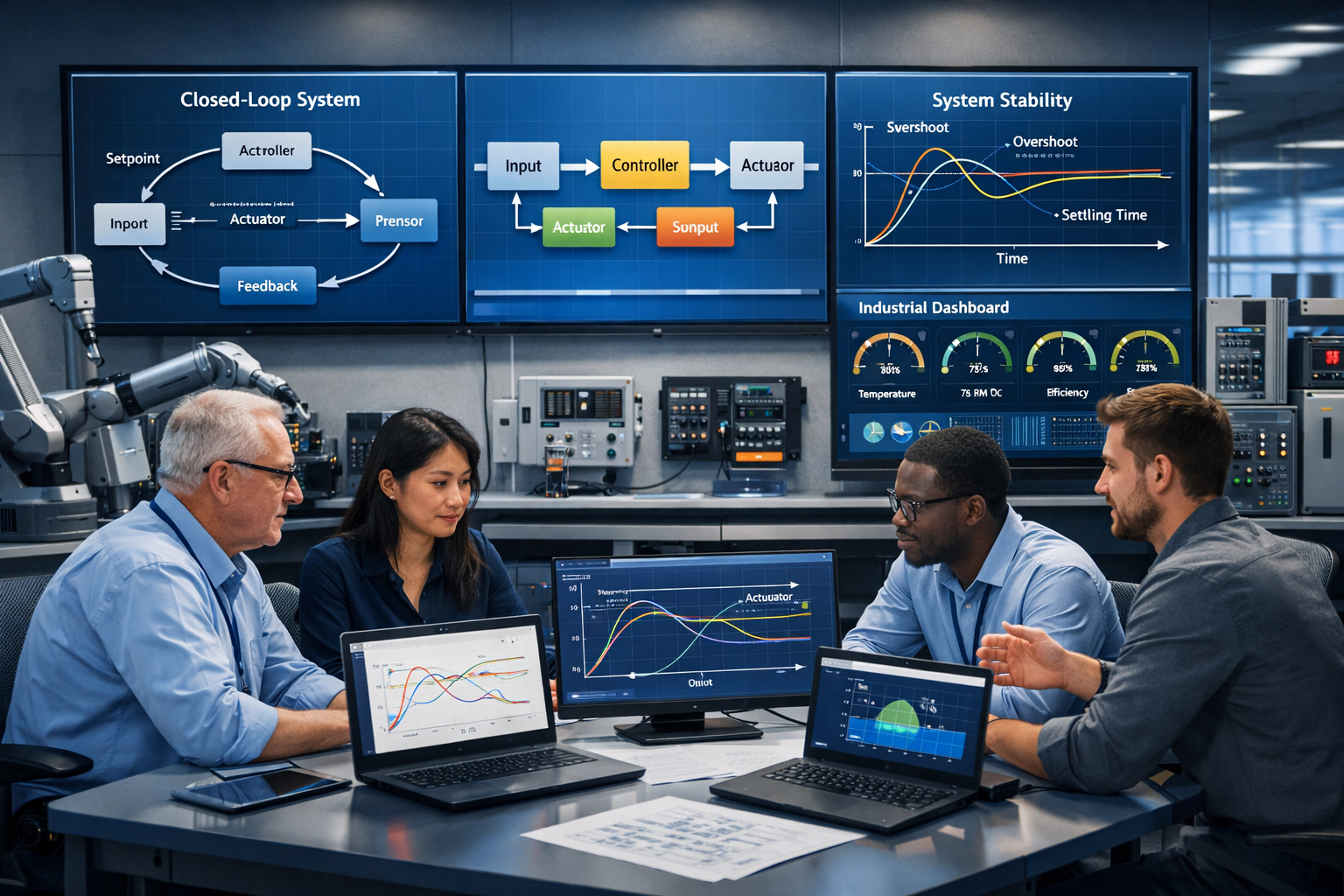
Engineering systems power nearly every aspect of modern life. From transportation and manufacturing to robotics and energy production, these systems combine mechanical, electrical, and digital components to perform specific tasks. At the center of many of these applications lies one essential concept: control systems.
If you’re new to engineering, this guide will help you understand how these systems work, why they matter, and how they are applied in real-world scenarios—without overwhelming technical complexity.
What Are Engineering Systems?
An engineering system is a structured arrangement of components designed to achieve a defined objective. These components may include:
- Mechanical devices
- Electrical circuits
- Sensors and actuators
- Software algorithms
- Communication networks
For example:
- A power plant generating electricity
- A robotic assembly line in a factory
- A smart home climate system
- An aircraft navigation platform
These systems must operate accurately and reliably. That reliability is achieved through well-designed regulation and monitoring mechanisms.
Understanding Control Systems
A control system is a mechanism that manages and regulates the behavior of another system. For a more detailed technical introduction, you can review this overview of control system fundamentals.
In simple terms, it keeps things on track.
Examples include:
- A thermostat maintaining room temperature
- Cruise control keeping a car at constant speed
- An industrial robot positioning parts precisely
Without proper regulation, machines would drift away from intended performance levels.
Why Regulation Matters in Engineering?
Modern engineering applications demand precision. Effective regulation provides:
- Stability
- Accuracy
- Safety
- Energy efficiency
- Reduced human intervention
Imagine an aircraft without automatic stabilization or a factory line without automated speed adjustments. Performance would be inconsistent and potentially dangerous.
Reliable system management ensures predictable outcomes even when external conditions change.
Core Components of a Control System
Most regulated systems include five basic elements:
1. Input (Setpoint)
The desired value or goal.
Example: Setting temperature to 22°C.
2. Controller
The decision-making unit that compares actual output to the desired input.
3. Actuator
The device that carries out corrective action.
Example: A heating element turning on.
4. Process (Plant)
The system being regulated, such as a motor, room environment, or engine.
5. Sensor
Measures actual performance and sends data back to the controller.
These components form a loop that continuously monitors and adjusts performance.
Open-Loop vs Closed-Loop Systems
There are two primary approaches to system regulation.
Open-Loop Systems
An open-loop configuration operates without feedback. It does not measure the output to verify accuracy.
Example:
A microwave running for a fixed time regardless of food temperature.
Advantages:
- Simple design
- Lower cost
- Easy implementation
Limitations:
- No automatic error correction
- Less accurate under changing conditions
This type works best when operating conditions remain predictable.
Closed-Loop Systems
A closed-loop configuration uses feedback to compare output with the setpoint. Adjustments are made automatically to reduce error.
Example:
A thermostat that continuously monitors room temperature.
Advantages:
- Higher precision
- Improved stability
- Automatic correction
Limitations:
- More complex
- Requires sensors and monitoring
Most modern engineering applications use closed-loop designs because they maintain consistent performance.
The Role of Feedback
Feedback is the foundation of effective regulation.
In a feedback loop:
- Output is measured.
- It is compared to the desired value.
- Any difference (error) triggers corrective action.
The most common form is negative feedback, which reduces deviations and improves stability.
Positive feedback exists but is typically used in specialized systems where amplification is required.
Important Performance Concepts
Beginners should understand these key ideas:
Stability
A stable system returns to its desired state after disturbance.
Accuracy
How closely output matches the setpoint.
Response Time
How quickly adjustments occur after a change.
Overshoot
When output temporarily exceeds the target before settling.
Steady-State Error
The remaining difference after stabilization.
These principles guide engineers when designing automated regulation strategies.
Analog and Digital Approaches
System regulation can be categorized by signal type.
Analog Systems
- Use continuous electrical signals
- Common in older equipment
Digital Systems
- Use discrete signals
- Controlled by microcontrollers or computers
- Standard in modern applications
Digital regulation offers flexibility, programmability, and improved accuracy, making it dominant in today’s industry.
Practical Applications in Industry
Control technology is applied across nearly every engineering discipline.
Automotive Engineering
- Cruise speed management
- Anti-lock braking systems
- Engine performance optimization
Aerospace
- Flight stabilization
- Autopilot navigation
- Satellite orientation
Manufacturing
- Robotic arms
- Conveyor belt speed control
- Temperature regulation in processing plants
Energy and Power
- Voltage regulation
- Turbine speed management
- Grid frequency stabilization
Robotics and AI
- Motion tracking
- Autonomous navigation
- Precision positioning
These applications demonstrate how regulation ensures safe, consistent, and efficient operation.
Common Control Strategies
Engineers use several methods to achieve stability and precision.
On-Off Control
Simple switching method (e.g., heater turning on and off).
Proportional (P) Control
Adjustment proportional to the size of the error.
Proportional-Integral-Derivative (PID) Control
The most widely used industrial strategy.
PID combines:
- Proportional correction
- Integral adjustment
- Derivative prediction
When properly tuned, PID control provides fast response with minimal error.
The Role of Mathematics and Modeling
Advanced design relies on mathematical tools such as:
- Differential equations
- Transfer functions
- State-space models
- Laplace transforms
Engineers use simulation software to test system behavior before real-world deployment. This reduces cost and improves reliability.
While beginners don’t need deep mathematical knowledge immediately, understanding that modeling drives design is important.
Challenges in System Regulation
Designing stable automation is not always straightforward. Engineers must address:
- Signal noise
- External disturbances
- System delays
- Nonlinear behavior
- Wear and component aging
Proper testing, tuning, and monitoring are essential for long-term reliability.
The Future of Engineering Regulation
Technology continues to evolve. Emerging trends include:
- AI-driven adaptive control
- Smart factories (Industry 4.0)
- Autonomous vehicles
- Internet of Things integration
- Predictive maintenance
Modern engineering systems are becoming smarter, more connected, and capable of real-time optimization.
The demand for advanced control systems will continue to grow as industries automate further.
Final Thoughts
Control systems are a cornerstone of modern engineering systems. They ensure stability, precision, and safety across industries ranging from aerospace to manufacturing.
For beginners, focus on understanding feedback, system components, and performance characteristics. These fundamentals form the foundation for more advanced study.
As technology advances, expertise in regulation and automation will remain one of the most valuable skills in engineering. Whether you’re exploring a career path or expanding your technical knowledge, mastering these principles opens the door to countless opportunities in modern engineering.