
 By Robert Smith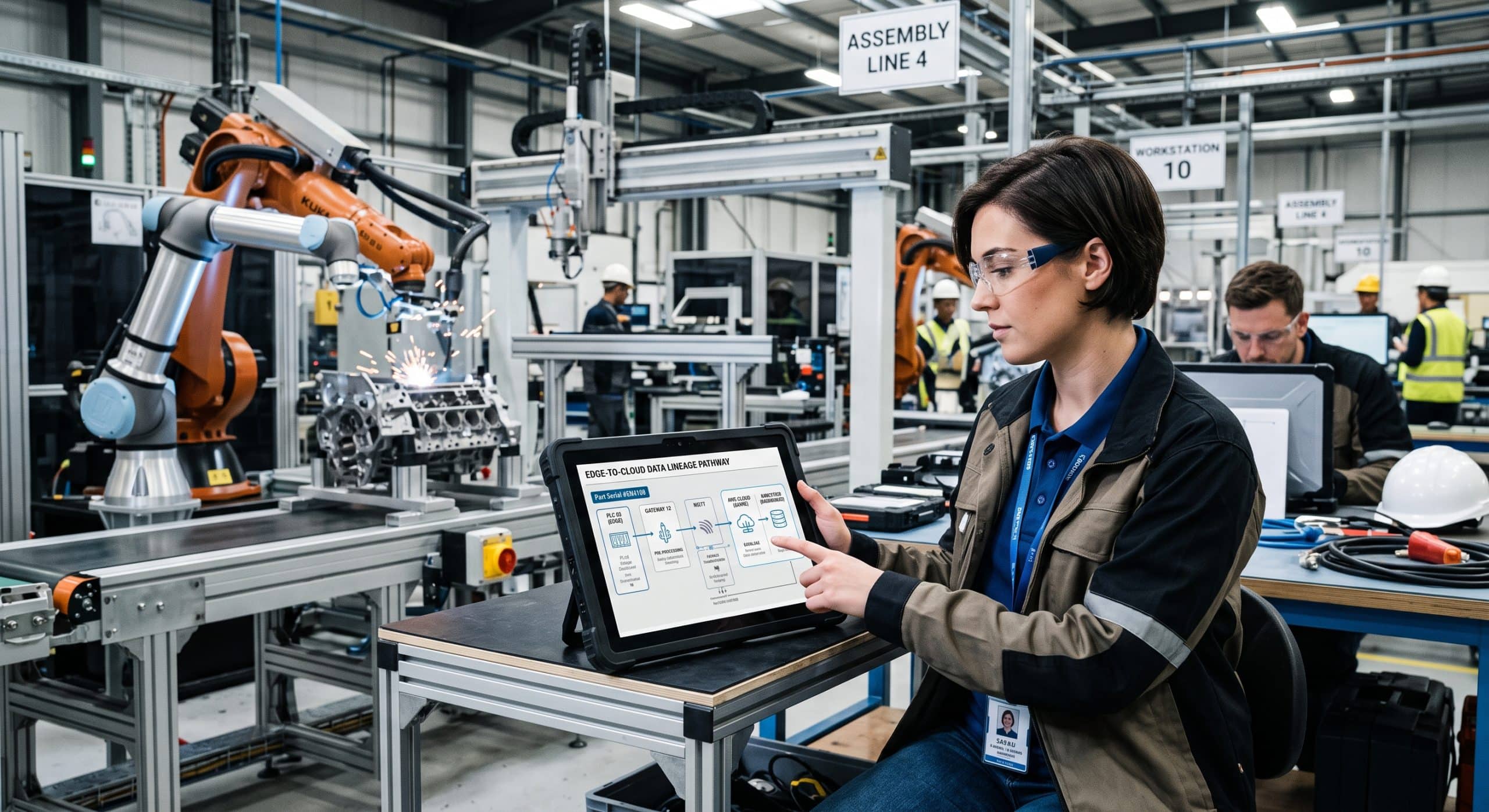
I’ve spent 12 years building and rebuilding platforms for data lineage in factories. One question still catches plant managers off guard: “Can you show me exactly where that number came from?” Not the number itself — the origin. What sensor recorded it, what shift produced it, and what firmware version ran on the PLC. In most shops, teams can answer that for the last hour of production. Even so, very few can answer it for a batch that shipped eight months ago and just triggered a customer complaint.
That gap is what data lineage in factories closes, though it’s messier than the phrase suggests. On paper, lineage looks like a diagram: arrows connecting a sensor to a database to a report. In practice, a real production line looks nothing like that. It’s a tangle of protocols, buffers, historians, MES exports, and cloud pipelines. Add one more thing: a spreadsheet somebody built in 2019 that nobody’s allowed to touch. Getting from raw edge signals to a trustworthy, auditable record takes real work. In fact, vendor slide decks rarely mention that part.
This piece walks through how that tracking works end to end. It focuses on why data lineage in factories matters most in compliance and quality contexts. And it shares hard-earned lessons on building systems that survive an audit, a recall, or a regulator’s phone call.
What Data Lineage in Factories Actually Means
Strip away the marketing language and data lineage in factories is simply a record of custody. Specifically, it answers three questions for every piece of operational data. Where did this value originate? What happened to it on the way to storage? And who or what touched it along the way? In short, that’s it — no mysticism required.
The complication is scale and heterogeneity. For example, a single mid-sized plant might run 12 or more distinct machine types on one line. Each speaks its own protocol — Modbus here, EtherNet/IP there, an ancient RS-232 link on a machine older than some of the operators running it. That machine reports to a PLC, which feeds a historian or a SCADA layer. In turn, the SCADA layer may or may not feed an MES. When it does, the MES pushes data into a cloud platform, and that’s where quality engineers, plant managers, and auditors go looking for answers.
As a result, every hop in that chain creates risk. A timestamp can drift, or a unit can silently convert to the wrong scale. Batch IDs can drop. An “improved” recalculation can overwrite a value without anyone logging it.
That’s why lineage isn’t a nice-to-have layered on top of that chain after the fact. Instead, teams need to build it into the chain itself — tagging data at the point of capture and carrying that tag forward, hop by hop. Do that well, and a quality engineer six months from now can reconstruct the exact path a reading took from sensor to report without guessing.
The Edge-to-Cloud Journey: Where Operational Data Actually Comes From
The ISA-95 Layers, in Practice
Start at the source. On the shop floor, the ISA-95 model still holds up reasonably well as a mental map, even though real deployments never respect its boundaries as cleanly as the standard implies. Sensors, actuators, and the controllers reading them sit at levels 0 and 1: pressure transducers, vibration sensors, torque wrenches with embedded logging, vision systems checking for surface defects. Supervisory control — your SCADA and HMI layer — sits at level 2. Manufacturing operations management, typically an MES tracking work orders, genealogy, and quality holds, occupies level 3. The business layer sits at level 4: ERP, planning, the systems finance actually looks at.
Where Lineage Gets Made or Lost
Edge computing now sits mostly at levels 1 through 3, and that shift has changed how teams build lineage. Instead of every raw tag streaming straight to the cloud, an edge gateway typically ingests signals locally. It stamps them with a source timestamp, then adds context: work order ID, station number, operator badge. Buffering and forwarding come next.
In practice, that local contextualization step decides whether good lineage survives or dies. If the gateway doesn’t stamp a reading with its originating asset ID and a UTC-normalized timestamp before the reading leaves the plant network, nobody can reliably reconstruct it later. Cloud-side enrichment can add business context afterward, but it can’t manufacture provenance that was never captured in the first place.
OPC UA has become the practical backbone for a lot of this. It carries semantic metadata alongside the raw value instead of just a bare number on a wire. A tag isn’t just “47.3” — it carries its unit, its quality flag, its source node, and a server timestamp. In turn, a lineage system needs exactly that metadata to hook into. Investing in a proper OPC UA information model at the edge pays off later, when someone has to explain a data point to an auditor rather than a machine.
The Edge-to-Cloud Handoff
From the edge, data typically moves through a message broker — MQTT is common on the plant floor. From there, it heads into either a local historian for real-time operations or a streaming pipeline bound for the cloud. This handoff is the single most common place lineage breaks. Network interruptions cause buffering and batched retransmission, and that can scramble the apparent sequence of events if nobody handles timestamps carefully. Transformations happen along the way too: unit conversions, aggregations, deduplication. Skip logging those steps as part of the pipeline’s own metadata, and trouble follows. The cloud data lake fills with numbers that look authoritative but can’t trace to one sensor reading at one moment.
Once data lands in the cloud, it usually passes through a landing zone first. There, teams cleanse it and join it against MES and ERP context. Then it reaches whatever analytics or quality platform the plant uses. Overall, a mature architecture treats every one of those stages as a lineage checkpoint, not just a processing step. It records what ran, when, on which version of the transformation logic, and what the inputs and outputs were.
Manufacturing Compliance & Quality Control: Auditing Production Steps
What an Audit of Production Steps Actually Asks
This is where data lineage in factories stops being an engineering nicety and becomes a legal and financial necessity. Quality control in a regulated manufacturing environment isn’t really about catching defects at the end of the line. Instead, it’s about proving, after the fact, exactly how a product was made.
An audit of production steps asks something deceptively simple. For this specific unit or lot, show every process step it went through and the parameters at each one. Show who or what performed the step, too, and the pass or fail criteria at each quality gate. Teams without solid lineage reconstruct this from a patchwork of MES exports, paper travelers, and institutional memory. That patchwork is exactly how audits turn into multi-week fire drills instead of routine checks.
Turning an Audit Trail Into a Query
With proper data lineage in factories in place, an audit trail becomes a query instead of an investigation. Pull the batch ID, and the system returns the full genealogy. Raw material lot numbers. The machine and tooling used at each of, say, 12 sequential process steps. The operator or automated station responsible for each one. Sensor readings captured during the step. The quality checkpoints the unit passed through. In fact, none of that is hypothetical. It’s the baseline expectation under ISO 9001 clause 8.5.2 on identification and traceability. Likewise, IATF 16949 makes it a hard requirement for automotive suppliers. So does 21 CFR Part 11 for regulated pharmaceutical and medical device manufacturing. There, data integrity has to meet the ALCOA+ principles: attributable, legible, contemporaneous, original, and accurate, among other criteria.
I’ve sat through audits where a clean pass or a finding came down to one thing. Could the plant show an unbroken chain from raw sensor data to the finished-goods record? In fact, auditors don’t just want the final number. They want proof that nobody quietly edited it somewhere in the pipeline without leaving a record of who changed it and why. That’s lineage doing its actual job — not a reporting feature, but evidence.
Defect Origin Tracking: Following the Thread Backward
Tracing Backward Through the Graph
Compliance audits trace forward, from raw material to finished product. In contrast, defect origin tracking asks the opposite question, usually under more pressure. A customer reports a failure, or a downstream test catches a defect. Either way, someone needs to figure out how far back the problem goes and how many other units it touched.
This is genealogy tracing in its purest form, and it’s where weak data lineage in factories gets exposed fastest. Say a batch of components fails a stress test three weeks after production. The investigation needs answers fast. Which machine ran the batch? Did a tooling change or calibration drift happen in that window? Which raw material lot fed into it? And critically, what other batches share that same upstream lot or machine state? Lineage that only tracks forward references — this material became this product — creates a problem. Skip backward indexing — product to material, machine, operator, environmental condition — and that second question gets hard. It turns into a manual search through logs nobody designed for searching.
For this reason, good data lineage in factories takes the shape of a graph, not a chain. Every node — a material lot, a machine run, a calibration event, a quality check — links bidirectionally to everything that touched it. When a defect surfaces, investigators aren’t reconstructing a story from scratch; they’re traversing a graph that already exists. I’ve watched root-cause investigations shrink from two weeks to under a day once a plant put this graph structure in place, replacing MES reports that only answered forward-looking questions.
Why Sensor-Level Lineage Matters
In addition, sensor-level data lineage in factories matters more than most quality teams initially assume. A defect isn’t always caused by a bad material lot. Sometimes it’s a torque sensor that drifted out of calibration for four hours before anyone noticed, silently affecting every unit that passed through that station in the window. Without edge-level lineage tying sensor readings to specific timestamps and asset IDs, that four-hour window stays invisible until someone gets lucky correlating complaint dates against a maintenance log by hand.
Maintaining ISO and Regulatory Standards Through Architecture, Not Paperwork
In practice, plenty of plants still treat regulatory compliance as a documentation exercise running alongside production instead of something built into the data architecture itself. That approach works fine until volume or complexity outpaces what people can manually track, and for most growing operations, that happens faster than expected.
Instead, the more durable approach designs the data architecture so compliance evidence becomes a byproduct of normal operation rather than a separate reporting task. Immutable event logs cover anything touching a quality-relevant parameter — once a reading is captured and contextualized at the edge, downstream systems can’t silently overwrite it. Corrections get appended as new events with their own lineage, never as edits that erase history. Transformation logic gets versioned too, so if a calculation behind a derived quality metric changes, someone can tell which historical records used which version of the logic. And metadata catalogs stay actually maintained, not built once for an audit and then abandoned.
Still, ISO 9001 and its sector-specific derivatives don’t mandate a particular technology stack. That’s honestly part of the problem — plants often build minimum-viable compliance rather than a system that scales. The standards are explicit about outcomes, though: traceability of nonconforming product, identification of status throughout production, and control of records. An architecture with strong data lineage in factories satisfies those requirements structurally, as a side effect of how data moves. It doesn’t need a bolt-on reporting layer maintained by whoever drew the short straw that quarter.
Building the Architecture: Governance at Scale
Getting the Foundations Right
Scaling this beyond a single line or a single plant is where most of the real difficulty lives, and it’s also where I’ve made my share of expensive mistakes.
First, standardize the metadata model before standardizing the tools. I’ve watched teams pick a data catalog or a historian platform first, then try to retrofit a consistent tagging scheme onto it afterward. In fact, it works better the other way around. Decide what every reading needs to carry: asset ID, timestamp, unit of measure, quality flag. Also decide who or what system originated it, and which transformation version touched it. Get the time zone handling nailed down. Enforce all of it at the edge gateway level before choosing which downstream tools consume the data.
Next, buffer intelligently at the edge, but log the buffering itself. Network drops are inevitable on a plant floor with 12-plus wireless access points and industrial interference everywhere. When a gateway buffers and retransmits, a gap appears. That gap and its fix belong in the lineage record — not in a log nobody in quality reads.
Governance Beyond the Data Itself
Also, resist the urge to centralize everything into one monolithic cloud pipeline. A layered approach works better: real-time decisions handled at the edge, contextualized data streamed to the cloud, heavier analytics and long-term storage living in the cloud. That layering tends to hold up better under both latency requirements and audit scrutiny than forcing every decision through a round trip to a data center.
One thing gets skipped constantly: building access and change lineage into the governance model too. Knowing who queried a quality record, and who had permission to modify a transformation rule, is itself a lineage question — and increasingly, it’s an auditor’s question. In short, data governance at scale isn’t just about tracking the data. It’s about tracking who’s allowed to touch the systems that track the data.
Overall, none of this counts as exotic engineering. It’s disciplined, occasionally tedious architecture work, and it pays off exactly when nobody wants to be improvising: mid-audit, mid-recall, mid-customer-escalation.
What I’d Tell a Plant Starting From Zero
If I were starting a lineage program today rather than 12 years into one, I’d resist the temptation to buy a platform first. First, start by mapping the actual data flow of one line, honestly, ugly parts included. That means the manual entry points and the spreadsheet nobody wants to give up. It also means the machine that still needs someone to walk over and read a gauge. In other words, nobody can architect lineage for a process they haven’t actually walked.
Next, prioritize the compliance-critical paths, not the flashiest dashboards. Quality holds, nonconformance records, and calibration events earn strong data lineage in factories before predictive maintenance dashboards do. The former protects a company legally. The latter just looks good in a demo. I’ve seen budget go the opposite direction more than once, and it’s a hard call to defend after the fact.
Finally, build for the audit nobody’s had yet, not just the one that just wrapped up. Standards get stricter, not looser, over time. Plants that treat lineage as living infrastructure, rather than a one-time compliance project, handle new regulatory requirements as a configuration change instead of a six-month emergency rebuild.
Closing Thought
In the end, data lineage in factories isn’t glamorous work. Nobody puts “built an immutable metadata schema for edge gateways” on a highlight reel. Picture a customer complaint on your desk, or an auditor asking you to prove a process-capability claim. Lineage marks the difference then: answering in minutes with confidence, or spending weeks reconstructing a story you hope holds together. Build it into the architecture from the sensor up, not the report down, and it stops being a project. Instead, it starts being infrastructure.
Frequently Asked Questions
The Fundamentals
What is data lineage in a manufacturing context, specifically?
It’s the traceable record of where an operational data point originated on the plant floor, every transformation or system it passed through, and where it ended up. In short, that covers both forward traceability (material to product) and backward traceability (product to origin). Databricks has a solid general breakdown of the concept: https://www.databricks.com/blog/what-is-data-lineage
Why does edge computing matter for lineage instead of just streaming everything to the cloud?
Context and provenance are best captured at the source, closest to the sensor or PLC, before network delays or transformations can obscure the original timestamp and asset identity. A good overview of the edge-cloud split in manufacturing is here: https://avassa.io/articles/smart-factories-edge-computing-manufacturing/
How does ISA-95 relate to building a lineage architecture?
ISA-95 gives you a shared vocabulary for the layers data passes through, from sensors and controllers up to MES and ERP. In turn, that helps standardize where lineage checkpoints should sit. The ISA’s own standard page is a good starting reference: https://www.isa.org/standards-and-publications/isa-standards/isa-95-standard
The Practical Details
What’s the difference between traceability and lineage in a quality management system?
Traceability is usually the compliance requirement — proving where a product’s components came from, per ISO 9001 clause 8.5.2. In contrast, lineage is the underlying data infrastructure that makes traceability provable at scale rather than reconstructed manually. This explainer covers the ISO 9001 clause directly: https://www.qualityze.com/blogs/iso-9001-clause-8-5-2-identification-traceability
Does OPC UA replace the need for a separate lineage system?
No. OPC UA standardizes how data and its immediate metadata move between machines and systems, which makes capturing lineage easier. However, it doesn’t store historical provenance or manage governance across a full edge-to-cloud pipeline on its own. More detail on what OPC UA actually does: https://www.advancedtech.com/blog/what-is-opc-ua/
How does defect origin tracking differ from a standard root-cause analysis?
Root-cause analysis is the broader investigative process. In comparison, defect origin tracking uses lineage data — machine states, sensor readings, material lots — to narrow that investigation down to an exact point of failure rather than a probable cause. Automate.org’s piece on managing industrial data touches on this operational angle: https://www.automate.org/ai/blogs/managing-industrial-data-to-from-and-between-the-cloud-and-the-edge
References
- Databricks. “What is Data Lineage?” https://www.databricks.com/blog/what-is-data-lineage
- Snowflake. “What is Data Lineage? Essential Enterprise Management Guide.” https://www.snowflake.com/en/data-governance/data-lineage/
- International Society of Automation (ISA). “ISA-95 Standard: Enterprise-Control System Integration.” https://www.isa.org/standards-and-publications/isa-standards/isa-95-standard
- Siemens. “ISA-95 Framework and Layers.” https://www.siemens.com/en-us/technology/isa-95-framework-layers/
- Advanced Technology Services (ATS). “What is OPC UA? Industrial Connectivity Standards.” https://www.advancedtech.com/blog/what-is-opc-ua/
- ARC Advisory Group. “OPC UA Unlocks Industrial Interoperability.” https://www.arcweb.com/blog/opc-ua-unlocks-industrial-interoperability
- Association for Advancing Automation (A3). “Managing Industrial Data To, From and Between the Cloud and the Edge.” https://www.automate.org/ai/blogs/managing-industrial-data-to-from-and-between-the-cloud-and-the-edge
- Avassa. “Edge Computing in Manufacturing: 2026 Smart Factory Guide.” https://avassa.io/articles/smart-factories-edge-computing-manufacturing/
- Qualityze. “ISO 9001 Clause 8.5.2 Identification & Traceability: Useful Info.” https://www.qualityze.com/blogs/iso-9001-clause-8-5-2-identification-traceability
- ComplianceQuest. “Quality and Traceability in Electronics Manufacturing.” https://www.compliancequest.com/blog/quality-and-traceability-in-electronics-manufacturing/