
 By Robert Smith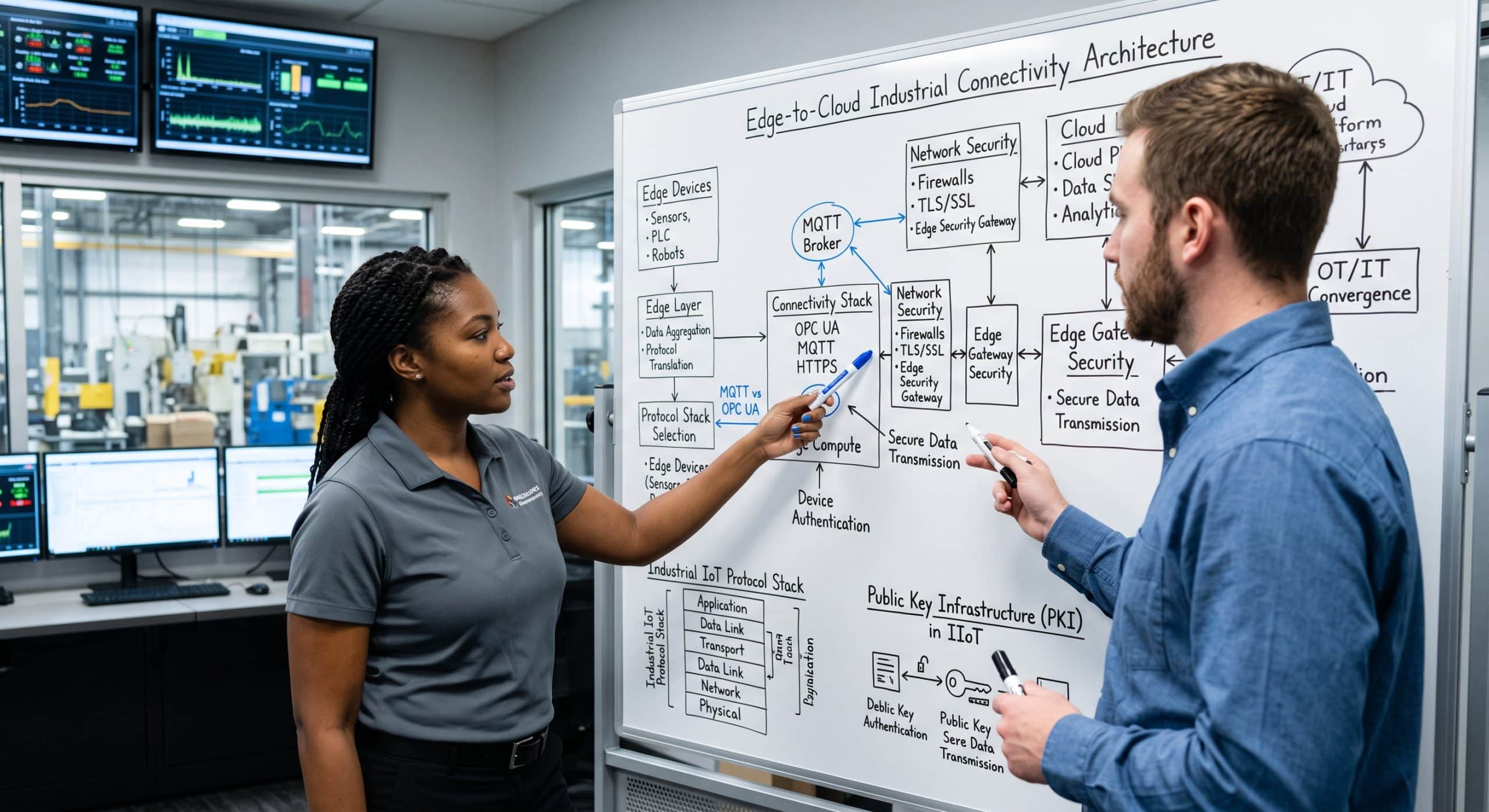
Building an effective Industrial Connectivity Architecture ensures industrial facilities no longer operate as isolated technology islands. Instead, control data moves seamlessly from field devices to enterprise systems and cloud platforms through this unified framework. Therefore, designing that data path correctly serves as the foundational requirement for modern automation.
Modernization is not simply a matter of connecting machines to the cloud. On the contrary, the architecture must preserve deterministic control and protect safety functions. It must also support legacy equipment and provide useful data context. Consequently, engineers favor a hybrid model that keeps time-critical control local while sharing trusted data higher up.
Why Industrial Connectivity Architecture Matters
A modern plant often contains equipment spanning several technology generations. For instance, a single line might include a legacy Modbus RTU controller alongside an EtherNet/IP drive system. It may also feature PROFINET I/O stations and OPC UA-capable SCADA servers.
Severe problems appear when engineers connect everything through direct, point-to-point integrations. In fact, this fragmented approach creates several major weaknesses. Every new system requires a custom interface. Data names and units lose consistency across platforms. Furthermore, engineers struggle to monitor network traffic effectively. Troubleshooting depends heavily on vendor-specific tools. Finally, a failure in one integration can easily affect unrelated systems.
To resolve these issues, the architecture should create clear functional boundaries. Specifically, it must define communication paths and govern protocol translation.
Above all, the control system must operate safely if external connections fail. Cloud analytics may improve maintenance planning over time. However, a PLC should never depend on an internet connection to execute an emergency stop.
The Edge-to-Cloud Design
The hybrid model offers the most practical architecture for modern plants. In this setup, fast response logic remains close to the process. Meanwhile, the edge layer prepares useful information for enterprise applications.
At the field level, sensors and actuators interact directly with controllers. As a result, the local PLC remains responsible for sequence logic and closed-loop control.
Meanwhile, the supervisory layer contains HMIs, SCADA servers, and local historians. This layer provides operator visibility. It also stores crucial information needed for daily troubleshooting.
Furthermore, teams usually begin modernization at the edge layer. An edge gateway reads data from multiple industrial protocols. It normalizes tag names and filters high-frequency values. It also buffers information during network outages.
In addition, the operations layer includes MES platforms and quality systems. These applications need contextualized data rather than raw register values. For example, the number “42.5” conveys little utility by itself. A meaningful event identifies the specific site, line, asset, and measurement unit.
Finally, the cloud layer supports fleet-wide reporting and long-term storage. It delivers exceptional value for workloads that do not need millisecond response times.
Ultimately, this separation avoids a common design mistake. Transmitting every raw tag directly to the cloud generates massive amounts of repetitive traffic. Edge processing transmits changes, aggregates, and exceptions instead.
Selecting Industrial Protocols
Engineers should base protocol selection on specific process requirements. Indeed, different protocols solve entirely different operational problems.
Modbus
Modbus remains common because it offers a simple, inexpensive structure. While Modbus RTU operates over serial networks, Modbus TCP uses Ethernet instead.
However, cybersecurity poses a major limitation. Traditional implementations lack native authentication or encryption. Therefore, operators should contain the protocol within a strictly controlled OT zone behind firewalls. It serves low-speed monitoring well, but engineers should avoid using it for safety-critical communication.
PROFINET
Automation teams widely deploy PROFINET for controller-to-device communication and distributed I/O. Specifically, it supports real-time communication across star, line, tree, or ring topologies.
Consequently, PROFINET represents a strong choice for plants using Siemens hardware. Additionally, it provides useful diagnostic data regarding network link status. Nevertheless, the architecture still requires segmentation because real-time capability does not guarantee cybersecurity.
EtherNet/IP
EtherNet/IP dominates Rockwell Automation environments. To manage traffic, it uses standard TCP/IP for explicit messaging. It also supports cyclic traffic for implicit control applications.
For this reason, engineers should carefully distinguish between control traffic and ordinary diagnostic traffic. Even though both share the physical network, they carry drastically different performance requirements.
EtherCAT
Designers explicitly built EtherCAT for ultra-fast, synchronized motion applications. Thus, it provides exceptional performance in robotics and packaging systems.
However, its advantages yield the most value during tight synchronization tasks. By contrast, general plant monitoring makes its high speed unnecessary. A simpler protocol reduces engineering effort significantly in those scenarios.
OPC UA
Integrators frequently use OPC UA as an interoperability layer. Because it supports structured information models and strong encryption, it works ideally for modern integration.
In practice, OPC UA excels at bridging PLCs, SCADA systems, and edge gateways. However, a secure deployment requires active certificate management and strict user permissions. Enabling OPC UA without managing credentials fails to create a secure architecture.
MQTT
MQTT provides a lightweight publish-and-subscribe protocol for edge-to-cloud data movement. It separates data producers from consumers through a broker. This structure prevents applications from opening direct connections to the underlying PLC.
Furthermore, MQTT proves exceptionally valuable when network bandwidth drops. Teams should configure Quality of Service settings based on data stream importance. Note, however, that engineers should reserve MQTT for analytics data rather than deterministic control.
Sparkplug and Unified Namespace
A structured MQTT model, such as Sparkplug, makes industrial data vastly more useful. The ultimate goal requires publishing information with consistent naming and context.
For instance, a practical namespace identifies the enterprise, site, area, line, cell, and asset. While the exact structure varies, consistency matters far more than specific terminology. Inconsistent naming forces enterprise applications to perform unnecessary data transformations later.
Security by Design
Industrial cybersecurity must protect availability, integrity, and safety. After all, a security design that interrupts production introduces a serious operational risk.
Segment the Network
Do not place PLCs, SCADA servers, and cloud gateways on one flat network. Instead, use zones and conduits to control communication between areas.
Engineers should organize the network into logical layers. The Cell Zone handles direct machine control. Above that, the Control Zone contains PLCs executing real-time logic. The Supervisory Zone houses SCADA systems and local historians. The Industrial DMZ provides isolation at the OT and IT boundary. Finally, the Enterprise Network contains business applications, while the Cloud Zone supports analytics.
Importantly, the Industrial DMZ should broker all exchanges between OT and IT. Firewalls should always enforce a default-deny rule for unapproved ports.
Protect Legacy Protocols
Plant owners cannot replace many legacy protocols quickly. Therefore, unencrypted buses will remain in service.
However, engineers can still protect the surrounding environment. Compensating controls include keeping legacy devices inside restricted zones. Teams should block unnecessary routing and monitor traffic continuously for abnormal commands. Deploying secure gateways for northbound data exchange also protects legacy hardware effectively.
Secure Remote Access
Remote access represents a critical attack vector. Therefore, teams should strictly avoid exposing PLC programming ports directly to the internet.
Instead, a stronger approach uses a VPN with multi-factor authentication. Administrators should mandate hardened jump servers and individual user accounts. Furthermore, keep vendor access disabled when maintenance is not occurring.
Manage Certificates and Identities
OPC UA and MQTT deployments depend heavily on certificates. Therefore, administrators must take explicit responsibility for issuing, renewing, and backing up credentials.
Likewise, shared credentials make auditing impossible. Using individual accounts and role-based permissions improves overall system accountability significantly.
Include the Physical Layer
Finally, industrial security does not stop at the software firewall. Cabinets, USB ports, and wireless access points all require physical protection.
Technicians should install industrial-rated switches and suitable cable shielding. Above all, management must restrict physical site access to authorized personnel.
Choosing the Right Stack
A good stack best fits the process, existing equipment, and engineering skill set.
In a well-designed architecture, data flows vertically across four core tiers. At the foundation lies the Control Layer executing local logic. Directly above it, the Edge Layer performs protocol conversion and data filtering. The Edge Layer then communicates upward to the Enterprise Layer using OPC UA or a Unified Namespace. At the top, the Cloud Layer receives data through MQTT via the Industrial DMZ.
Selecting the right stack requires evaluating each layer systematically. Start with the control platform based on required speed and safety certifications. Next, define edge functions like buffering, data compression, and local alarming. Avoid loading non-critical software onto critical control platforms. For the data layer, define tag ownership rules before connecting analytics tools. At the enterprise level, ensure business applications consume governed data rather than polling PLCs directly. Finally, evaluate cloud services based on latency, data residency, and integration costs.
The 9-Stage Stack Selection Process
A systematic selection process begins by documenting existing assets and protocols. Following that step, teams classify data by operational importance. Next, engineers define latency and retention requirements. Once teams clarify these needs, they map network zones and select edge gateways. Designers then establish standard naming rules and metadata formats. Finally, specialists test performance in a lab, pilot the design locally, and roll out the architecture in phases.
Commissioning and Maintenance
Connectivity projects often fail because teams do not validate designs under stress. For this reason, test the network with expected control traffic, diagnostics, and historian queries active simultaneously.
Specifically, measure packet loss, jitter, reconnect behavior, and gateway CPU usage. Disconnect network paths deliberately to confirm that local control remains safe during outages.
Equally important is documentation. Operations teams must maintain current network drawings, IP address records, switch configurations, and recovery procedures.
Ultimately, personnel should know how to isolate problems quickly. Clear diagnostic boundaries reduce downtime and prevent unnecessary changes to functioning control logic.
Frequently Asked Questions
What is Industrial Connectivity Architecture?
Industrial Connectivity Architecture is the structured design used to connect field devices, PLCs, edge gateways, enterprise applications, and cloud platforms. It defines communication paths, network security, and data models.
Should industrial control systems connect directly to the cloud?
No. Teams should always keep time-critical control local. A secure edge layer should process data before transmitting approved metrics to cloud services.
Is MQTT a replacement for OPC UA?
Not exactly. OPC UA excels at structured industrial interoperability and client-server communication. By contrast, MQTT optimizes lightweight data distribution across wide-area networks. Many modern architectures deploy both together.
Can Modbus be used in a modern plant?
Yes, especially for non-time-critical monitoring of legacy assets. However, operators should isolate it through network segmentation because standard Modbus lacks built-in security.
What belongs at the edge?
Edge systems handle protocol translation, filtering, buffering, and local analytics effectively. Conversely, they should not replace PLC safety logic unless explicitly certified for that control responsibility.
How should a Unified Namespace be designed?
Use a consistent hierarchy that provides operational context. Define naming conventions, measurement units, and data ownership before scaling beyond the pilot phase.
How often should industrial networks be reviewed?
Specialists should review networks after major equipment changes or security incidents. In general, a formal annual review serves as a practical baseline for most facilities.
What is the most common modernization mistake?
The most common mistake involves treating connectivity as a simple data-collection exercise. In reality, a successful architecture must address control independence, cybersecurity, data context, and recovery mechanisms.
References
- HiveMQ: Industrial IoT Solutions — Guide to Platforms, Connectivity, and Industrial Data Architecture
- Fortinet: IEC 62443 Standard for Industrial Automation and Control Systems Security
- NIST: Cybersecurity Framework (CSF) 2.0
- OPC Foundation: OPC Unified Architecture Specifications
- OASIS Open: MQTT Version 5.0 Protocol Specification